An AEO AI Approach for Ecommerce Brands: Help Shoppers Choose
Use decision rules, product stories, honest comparisons, and reliable offers to connect AI discovery to the right purchase

Rod Stockebrand
Co-founder, Brandleap.ai
Key Takeaways
Short on time? Here are the top things to know.
Article framework
How the key ideas connect
What is an AEO AI approach for ecommerce brands?
How is this different from optimizing product data?
Which playbook plays are most useful?
Does a feed guarantee an AI shopping recommendation?
How should ecommerce brands evaluate AEO?
A shopper does not always start with a product name. They may ask for a commuter backpack that fits a 16-inch laptop, stands up to rain, and stays below a particular budget. An answer system then has to translate those constraints into candidates, compare trade-offs, and identify a merchant. If your site offers only a lifestyle paragraph and a size dropdown, it leaves much of that decision to other sources—or to inference.
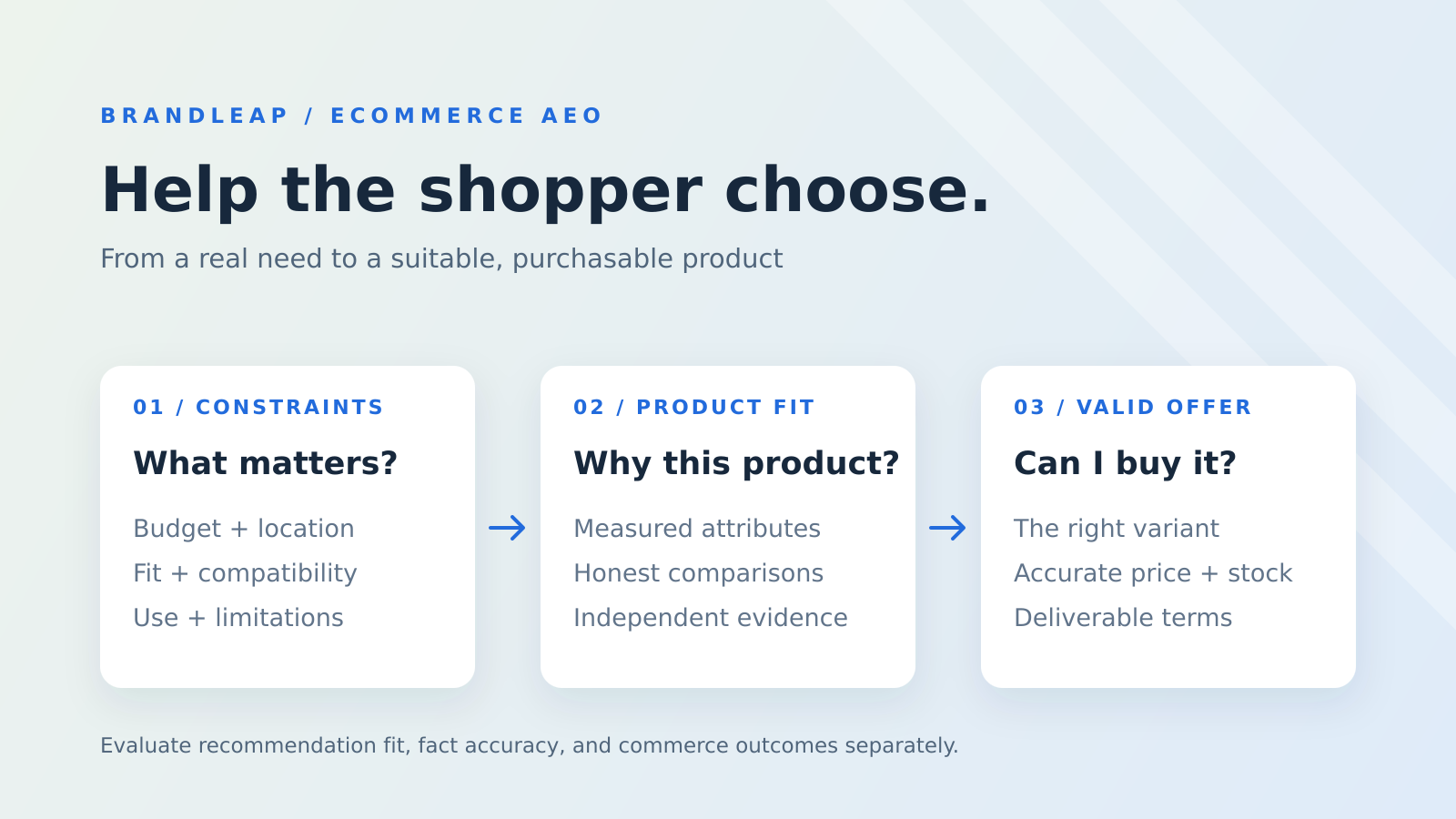
An AEO AI approach for ecommerce brands begins with that decision, not with another generic “best products” article. The objective is to make the correct product recommendable for a specific need and purchasable on accurate terms. Brandleap’s playbook provides useful building blocks: The Buyer’s Decision Tree, Product Story Architecture, Head-to-Head Play, Use-Case Matrix, and Product Feed Pipeline. Here is how to connect them without treating any play as a guaranteed ranking lever.
Separate discovery, recommendation, and offer selection
These are three different jobs. Discovery finds possible products. Recommendation decides which candidate fits the shopper’s constraints. Offer selection identifies a purchasable variant and merchant. A strong description can support the first two while a stale price undermines the third. Conversely, a perfect feed can describe a product accurately without explaining whether it fits an unusual use case.
OpenAI’s shopping documentation describes product selection using the query and context, structured metadata from first- and third-party providers, and other third-party content. It also notes that descriptions and review summaries may be generated, and pricing updates can take time to appear. Google’s AI-feature guidance emphasizes the existing SEO foundations and current Merchant Center information. Those documented behaviors support working on evidence and data quality; they do not establish one universal shopping algorithm.
This article is about the decision layer. For variant identifiers, ProductGroup, price synchronization, and schema/feed reconciliation, use the linked product-data implementation guide. Do not replace that foundation with editorial content.
Play 05: The Buyer’s Decision Tree — translate constraints into rules
Start with customer-service questions, return reasons, onsite searches, and product-team knowledge. Remove personal information before using these sources for analysis. Group questions by constraints: fit, compatibility, performance, budget, delivery destination, maintenance, and exclusions. Then map each constraint to an attribute you actually know. “Good for commuting” is an interpretation; laptop compartment dimensions and loaded weight are inspectable facts.
Scenario: rain-exposed commute with a large laptop
Hard constraints:
  - device must fit the published compartment dimensions
  - delivered price must remain within the shopper budget
  - selected variant must ship to the shopper location
Preference:
  - lower loaded weight
Evidence needed:
  - dimensions, weight, water-resistance test and limitations
Recommend:
  - model A only when every hard constraint is satisfied
Do not recommend:
  - model B if the device exceeds its compartment dimensions
Publish the useful rules in a readable buying guide, not only inside an interactive quiz. A crawler or retriever should be able to find the conditions, recommendation, and exceptions without completing a session. State why a product fits and where it does not. If your catalog has no suitable option, say so. Recommending an unsuitable product may increase mentions while increasing returns and reducing trust.
Play 07: The Product Story Architecture — give each product a decision-ready page
Apply a repeatable product-detail-page structure to a pilot group. Open with what the product is and its intended use. Follow with measured specifications, who it suits, who should consider something else, compatibility or sizing guidance, care requirements, evidence, and links to alternatives. Keep essential information available in textual form; do not hide dimensions in an image or make a video the only explanation of a safety limitation.
- What it is: the product class, exact model, and variant context, without vague superlatives.
- Who it fits: explicit needs and constraints, supported by attributes rather than invented personas.
- What is measured: units, test conditions, methods, and qualifications for performance claims.
- What differs: the meaningful trade-offs against sibling products and genuine alternatives.
- What can be purchased: the selected variant, current offer, fulfillment region, and policy links.
For example, “weather-ready” does not establish waterproofing. Describe the test used, what was exposed, the duration, and the exclusions. Do not imply certification unless it exists and applies to the offered product. The same principle matters for skin-care claims, dietary suitability, electrical compatibility, or protective equipment: the limits of the claim are part of the product story, not disposable fine print.
Plays 04 and 08: compare trade-offs and cover distinct use cases
The Head-to-Head Play helps shoppers compare products on the same dimensions. Use like-for-like variants, dated prices, test conditions, and a clear account of who should choose each option. A brand-owned comparison should identify itself as such. Do not write a page that calls your product the winner in every row or makes unsupported claims about a competitor. When you cannot verify a competitor attribute, mark it unknown rather than filling the gap.
The Use-Case Matrix adds a different perspective: one product may be suitable for several needs, but each need can involve a different decision. Commuting, air travel, and outdoor use are not interchangeable. A useful guide might compare laptop fit, under-seat dimensions, and weather exposure respectively. Create a separate page only when the scenario warrants different evidence and recommendations; changing a place name or audience label on otherwise identical pages creates little value.
Keep content connected. The buying guide should link to the exact product family or variant destination, and the product page should link back to relevant guidance. Use descriptive links and consistent names. For discontinued products, preserve a clear explanation of replacements and differences. A model that was excellent for last year’s use case is not automatically equivalent to its successor.
Play 24: The Product Feed Pipeline — make the recommendation buyable
Once the decision content is credible, confirm that every destination describes an obtainable offer. Assign the commerce catalog as the authoritative source for identifiers, supported attributes, and offer updates. Define how changes reach product pages, structured data, and each provider’s feed. Set an internal freshness target based on how quickly price and inventory move; a monthly batch may be inappropriate for fast-changing stock.
Do not interpret the playbook’s list of shopping surfaces as one feed you can submit everywhere. Each provider has its own onboarding, policies, attributes, and availability. A Google Merchant Center feed is not automatically an OpenAI or Perplexity integration. Verify the provider’s current supported route before promising coverage. OpenAI documents direct-feed interest and Shopify Catalog integration; neither is a promise that an individual product will be selected.
Test the actual customer path after a price, inventory, or shipping-policy change. Check that the link selects the intended variant, that the delivered offer fits the claimed region, and that checkout honors the current terms. Record the version and update time of your own data, but recognize that an external platform may still display an older observation. Investigate the source of the mismatch rather than repeatedly rewriting the description.
Play 36: The YouTube Review Strategy — add independent decision evidence
Substantive video reviews can explain assembly, durability, fit, and long-term use in ways a catalog cannot. Work with qualified reviewers who can show methods and genuine limitations. Disclose samples, sponsorship, or affiliate relationships appropriately. Provide accurate technical documentation, but do not require a positive verdict. Publish your own accessible demonstrations and transcripts where you control the rights, with model and version information.
A review’s existence is not proof that a particular assistant will cite it. The useful asset is the independent observation and the decision detail it adds. Do not repeat the playbook’s broad assertion that YouTube has an unusually high citation weight as if every platform disclosed that weighting. Measure whether relevant reviews actually appear in your sampled answers.
Test shopping scenarios, not a single “best brand” prompt
Build a small benchmark across a representative product family. Include constrained discovery (“under this budget”), sibling comparisons, compatibility questions, geographic availability, and negative cases. Keep the exact wording, platform, date, locale, visible model or mode, and source links. Use fresh or documented session conditions and repeat the queries to expose variation. A personalized answer and a neutral observation are not interchangeable.
- Recommendation fit: did the suggested product satisfy every known hard constraint? Keep missing evidence separate from a verified pass.
- Product accuracy: were dimensions, materials, compatibility, and model relationships stated correctly?
- Offer accuracy: did the price, currency, selected variant, stock, and region match the observable merchant offer at test time?
- Source quality: did the answer cite a relevant product page, useful comparison, or credible review rather than an unrelated mention?
- Commerce outcome: review tagged or attributable referrals, conversion, returns, and customer feedback. Separate observed associations from causal claims.
A four-week ecommerce AEO pilot
Choose one product family rather than the entire catalog. In week one, identify five common buying scenarios and capture baseline answers. In week two, update the product pages and publish one decision guide plus one honest comparison. In week three, reconcile supported feeds and test changed offers and variant destinations. In week four, rerun the same scenarios and review recommendation errors with merchandising, content, and commerce engineering. The calendar is an internal shipping plan, not an external recrawl guarantee.
Scale only after the pilot demonstrates that the information is accurate and the customer journey works. More pages and more feeds cannot rescue unsupported claims or unsuitable recommendations. The practical AEO approach is to explain product fit, substantiate the explanation, and deliver the offer that explanation promises. That gives an answer system better material to use—and gives a shopper a better reason to buy.