Ecommerce Product Data for AI Search: Keep Product Pages, Feeds, and Offers in Sync
A product-specific operating guide to detail pages, Merchant Center feeds, variant identity, live price and availability, and Product structured data

Rod Stockebrand
Co-founder, Brandleap.ai

Key Takeaways
Short on time? Here are the top things to know.
Article framework
How the key ideas connect
What product information should be consistent for AI search?
Can Product schema replace a Merchant Center feed?
How should an ecommerce site represent variants?
What if price or inventory changes faster than pages and feeds?
Does valid Product schema make a product appear in AI answers?
Product discovery is a data consistency problem
A product can be described in several places at once: the product detail page (PDP), a Merchant Center feed, structured data embedded in the page, a product API, and the retailer’s own inventory and checkout systems. Each representation serves a different consumer. A shopper reads the page; a merchant platform ingests a feed; a search crawler can parse page content and markup; a transaction system decides what can actually be bought.
Those systems do not automatically share one synchronized truth. A page may show the current color and price while a feed still exports yesterday’s value. A Product object may describe the parent style but omit the selected size. A variant URL may load a default option instead of the item named in the feed. These are product-data problems before they are schema problems.
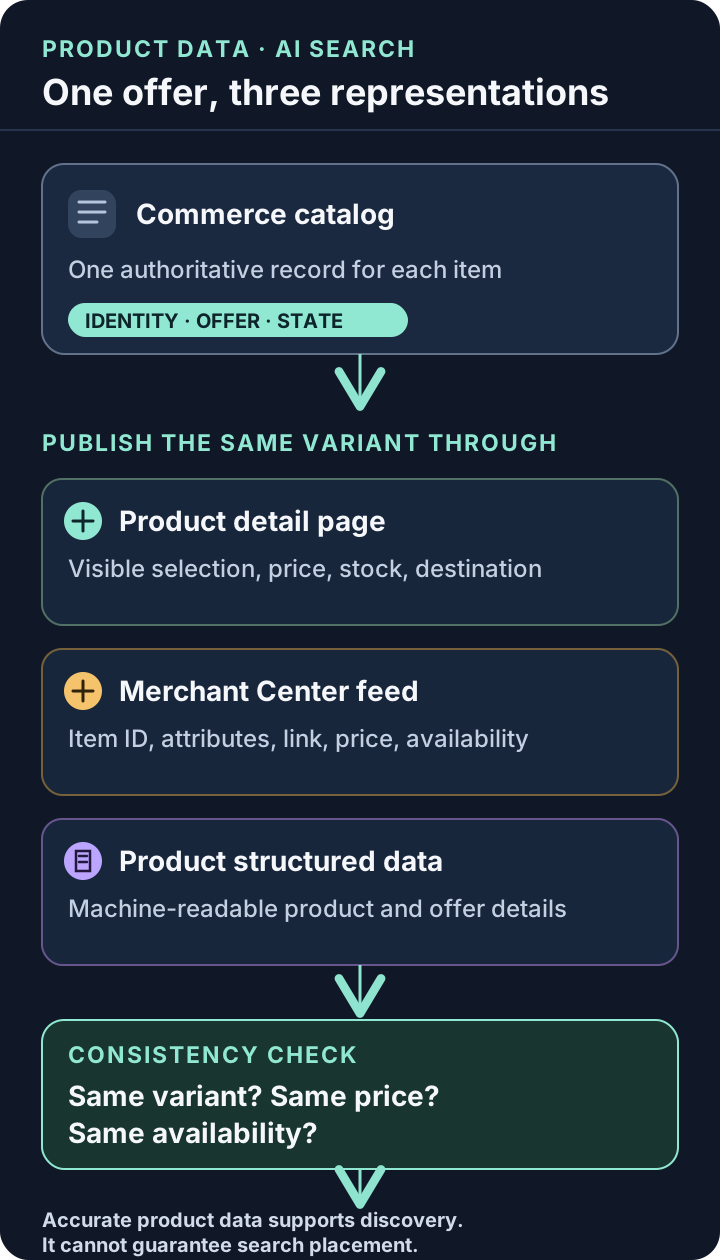
The operating goal is not to make three channels look similar. It is to make the PDP, submitted item, and structured offer resolve to the same purchasable variant at the same commercial moment.
This distinction matters for AI search because product questions are specific: “Is the navy jacket available in medium?”, “What does this model cost?”, or “Does this item come in a wide fit?” Search features and answer systems may combine page content, feeds, and other sources in ways that vary by product and platform. No markup or feed promises an AI mention. Clear, current, reconcilable product facts simply give systems and people less ambiguity to work around.
Start with the item a customer can actually buy
Before tuning a feed or writing JSON-LD, decide what counts as a product in your catalog. A style or model may have multiple colors and sizes, but a customer purchases a specific combination. The catalog needs a stable relationship between the parent product and each purchasable child variant. Its identifier should remain dependable across page rendering, feed export, and structured data.
- Assign a stable retailer identifier to each purchasable variant; do not recycle it for a different item.
- Preserve manufacturer identifiers such as GTIN or MPN when they genuinely apply. Do not invent identifiers to fill a field.
- Represent meaningful option values consistently: “navy” should not become “midnight” in one system and “blue” in another without an intentional mapping.
- Keep the parent relationship explicit, but do not mistake a parent style ID for the identity of every size-and-color offer.
- Choose a canonical destination that loads the intended variant and makes its selected options understandable to a shopper.
For a single-option item, one product page and one item may be straightforward. For a variant family, decide whether each variant has its own URL, whether query parameters select it, or whether a single URL changes state. Whichever design you choose, the selected variant must be visible and stable when someone lands directly on the URL. A feed link that opens the wrong color or a default size is a destination mismatch, even if the page eventually lets the shopper choose.
Parent product versus buyable variant
✗ Un-optimized
One parent record: “Trail jacket,” all options collapsed, generic price, and one stock flag.
✓ Triple-rich rewrite
A ProductGroup links distinct buyable variants; each variant has its own identifier, selected option values, landing destination, offer price, and availability where those differ.
The PDP is the evidence customers can inspect
A useful product page is more than a title, price, and image. Put the product identity and decision-making details in crawlable, rendered HTML: a clear name, manufacturer or brand where relevant, descriptive copy, material or dimensions when useful, variant selectors, current price and currency, and a visible availability or fulfillment message. Label caveats such as “preorder,” “ships later,” or “online only” in plain language.
Make the state of the page coherent after a direct visit, refresh, or client-side option change. If a user opens a size-specific destination, the selected size, price, stock message, and add-to-cart behavior should agree. Avoid making a critical fact available only after a hover, an inaccessible control, or a script interaction that fails without the intended runtime. This is not a demand to remove useful interactivity; it is a requirement that the product facts remain perceivable and render reliably.
- Show the current selling price and currency beside the purchase action, not only in a hidden data object.
- Distinguish unavailable, preorder, backorder, and in-stock states in customer language that matches fulfillment reality.
- State whether shipping, taxes, or condition affect the displayed amount when relevant to interpreting the offer.
- Ensure the selected variant and its availability update together; do not leave stale text after an option change.
- Keep product description, specifications, and images specific enough to distinguish this item from its sibling variants.
Treat Merchant Center as a separate product channel
A Merchant Center feed is not a mirror of your schema. It is a structured submission with required and recommended attributes, account and destination rules, and diagnostics. The product data specification defines fields such as ID, title, link, image link, availability, price, brand, and product identifiers. Populate attributes from the same catalog where possible, but map them deliberately: the feed has its own accepted field names, formats, rules, and review process.
The item ID submitted to a merchant platform should be stable and should identify the same item in subsequent updates. For variant catalogs, use an item-level ID and the variant attributes or group relationships required for your setup. The feed title and link should describe and land on the actual item. If your feed says “blue, size medium,” a destination opening in black and small is not repaired by a correct JSON-LD block on the page.
Feed acceptance is not the same as product approval, eligibility, or visibility. Read the platform’s current diagnostics and policies, investigate disapprovals, and make sure automated feed rules do not silently rewrite a valid catalog value into a misleading one. Google also documents automatic item updates for some data discrepancies; such mechanisms are not a substitute for fixing the authoritative source and routine export.
Price and inventory parity needs an owner and a clock
Price parity is often discussed as if there were one universally correct field. In practice, teams may have list price, sale price, member price, regional price, and a checkout-calculated total. Define which public offer the PDP and feed are representing, which currency and market it applies to, and how promotions start and end. If a sale price is exposed, its effective dates and visible presentation should match the current campaign. Do not publish a low price in markup while the customer sees a different mandatory price.
Availability has the same temporal problem. An inventory service may update continuously while feed delivery and page caches update on separate schedules. Establish an authoritative source, update path, cache invalidation policy, and a failure behavior. When the system cannot confidently confirm stock, use a truthful customer-facing state rather than retaining “in stock” indefinitely. For locations, pickup, or regional warehouses, avoid flattening location-specific truth into a global promise.
A useful parity review follows one variant end to end
✗ Un-optimized
Feed: available at the submitted price. PDP: selected option is unavailable, or checkout changes the price without explanation.
✓ Triple-rich rewrite
Catalog event updates the offer; the PDP and markup present that offer; the next feed submission carries the same item, destination, currency, price, and availability. A monitor flags disagreement for review.
Do not assume a crawler sees the same cached response as a shopper in every market or at every moment. Test representative URLs with normal rendering, inspect the source data feeding page and feed exports, and compare them against a controlled catalog record. Include promotion boundaries, low stock, backorder, discontinued items, and variant changes in the review set. The exact refresh cadence should follow your actual inventory volatility and channel requirements, not an arbitrary universal interval.
Use Product structured data to describe the visible offer
Product structured data gives search engines a machine-readable description of a product page. Product, Offer, and ProductGroup are relevant vocabulary; variant guidance describes how a group can connect variant products. The precise implementation should follow the search feature and markup documentation you intend to support. Google documents product snippets and merchant listing experiences separately, with feature-specific requirements. Check those current requirements rather than assuming every Product property is required or that every valid property qualifies for a rich result.
The key quality test is correspondence: values in the structured data must represent information users can find on that page. For a variant page, describe the selected variant and its current offer, and connect it to its group when that relationship is represented. Do not inject hidden aggregate reviews, a fabricated rating, a price range that does not apply to the selected item, or availability inherited from a different variant.
{
  "@context": "https://schema.org",
  "@type": "Product",
  "name": "{{ selectedVariant.name }}",
  "sku": "{{ selectedVariant.id }}",
  "color": "{{ selectedVariant.color }}",
  "size": "{{ selectedVariant.size }}",
  "offers": {
    "@type": "Offer",
    "url": "{{ selectedVariant.canonicalUrl }}",
    "priceCurrency": "{{ offer.currency }}",
    "price": "{{ offer.currentPrice }}",
    "availability": "https://schema.org/{{ offer.schemaAvailability }}"
  }
}
This is a template, not copy-ready markup: replace each expression with values from the same selected-variant and offer record used to render the visible page. Emit the correct Schema.org availability value for the actual state. Keep the page URL, currency, price, SKU, selected attributes, and availability aligned. If a field does not apply or cannot be validated, omit it rather than outputting a guess. Validate syntax and feature eligibility with the relevant Google tools, then inspect the live rendered page as well; a passing test cannot prove that your data will stay current.
Test data lineage, not just markup validity
A structured data validator can detect syntax and some eligibility issues, but it cannot establish that a sale price matches checkout, a product identifier belongs to the right variant, or a feed export is fresh. Build a product-focused quality check across the systems that actually publish offers.
- Select representative single products and variant families, including difficult cases such as preorder, sale, and location-specific availability.
- For each variant, compare catalog identity and option values with the selected PDP state, canonical destination, feed row, and rendered Product or ProductGroup data.
- Compare currency, current price, sale conditions, and availability with what the shopper sees and can complete at checkout.
- Check feed processing diagnostics and item-level errors separately from page markup validation.
- Recheck after catalog imports, theme releases, pricing changes, and inventory integrations; assign an owner for discrepancies.
- Record the time and market of each comparison so a temporary cache delay is not confused with a permanent mapping defect.
For AI search evaluation, keep the product-data quality task distinct from visibility measurement. First establish that an answer would have accurate, crawlable evidence to use. Then test representative product questions and record whether the result is discoverable, whether the answer gets variant and offer details right, and whether any cited destination supports those details. A citation is not proof of a correct live offer; correctness must be checked against the commerce system at the time of evaluation.
The practical standard: one offer, consistently described
Ecommerce product data for AI search is not a contest to emit the most properties. It is a discipline of identity, variant resolution, current commercial facts, accessible product content, and platform-specific feed quality. Product schema is one representation in that chain. A Merchant Center feed is another. The PDP remains the destination where customers should be able to confirm what they are buying.
When teams model variants deliberately, draw all representations from an owned source of truth, and test parity at the item level, they make product discovery more dependable for customers and systems alike. That work can improve eligibility for supported search features, but no source or markup can guarantee inclusion in an AI-generated response. Start with the factual contract: the product a person sees is the product the feed and page data say is available to buy.