AEO for Brands: Build a Brand AI Can Describe Accurately
A practical brand-building approach using entity clarity, verifiable claims, independent evidence, and repeatable answer testing

Rod Stockebrand
Co-founder, Brandleap.ai
Key Takeaways
Short on time? Here are the top things to know.
Article framework
How the key ideas connect
What is AEO for brands?
Which brand facts should you fix first?
Does Organization schema control AI answers?
How does independent evidence support brand building?
How should brands measure AEO?
A brand can appear in an AI answer and still lose. The answer might name the right company but describe an old product, attribute a competitor’s feature to it, invent a founding story, or recommend it to the wrong customer. That is visibility without reliable positioning. For brand teams, the useful question is not simply “Does AI mention us?” It is “Does the answer give someone a defensible reason to understand, consider, or reject us?”
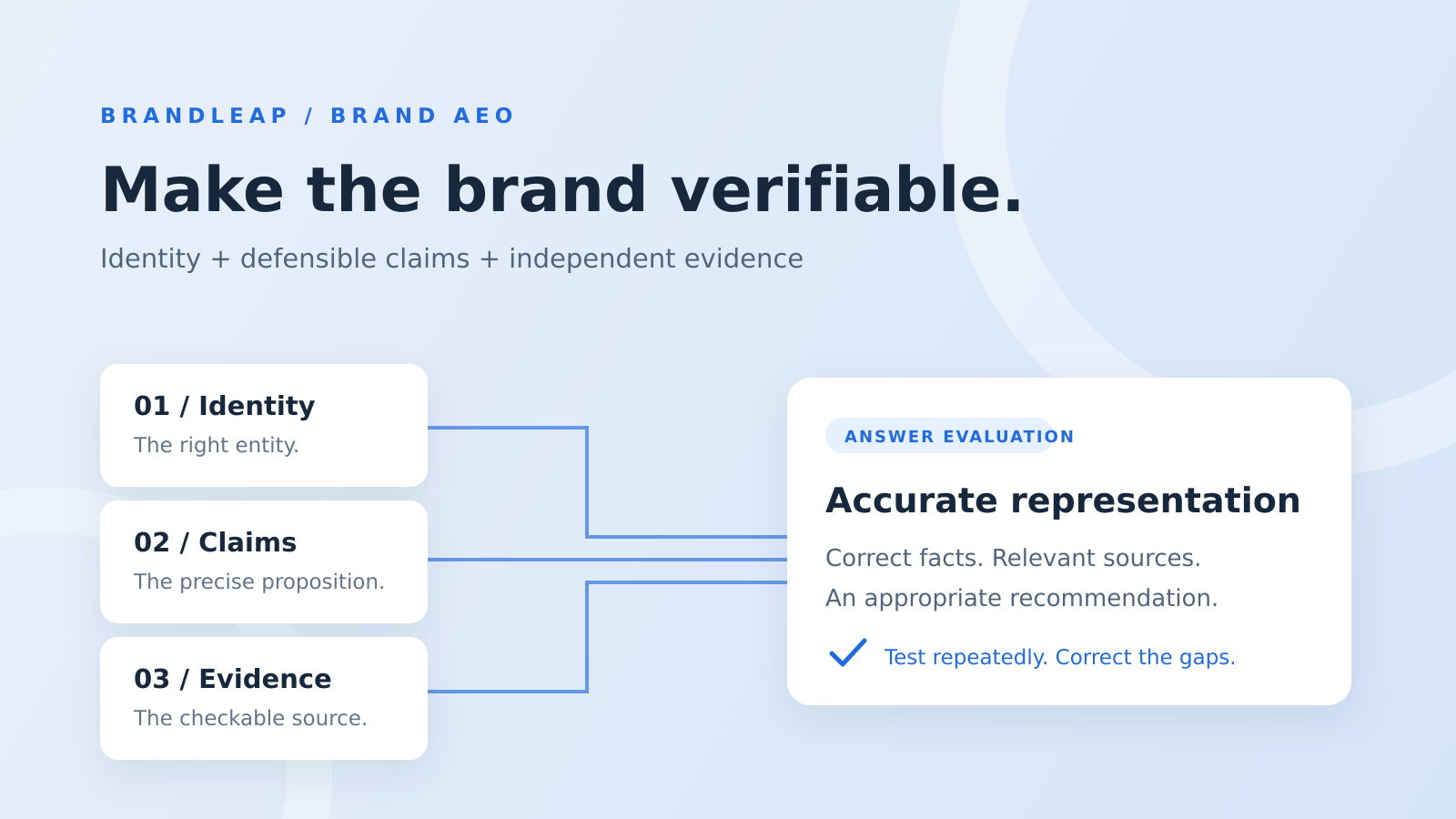
AEO for brands is the discipline of making that representation more accurate and useful. It connects brand strategy to the information an answer system can find: identity, category, audience, product relationships, claims, proof, and limitations. This article adapts five plays from Brandleap’s 2026 AEO playbook into a practical operating model. The plays are a way to organize work; they are not a formula for controlling proprietary AI rankings.
Start with a brand truth inventory, not a prompt campaign
Before writing more content, list the assertions you need a buyer to get right. Separate stable identity from changing commercial facts. A legal name may change rarely; ownership, service coverage, product availability, and eligibility rules can change quickly. Treat “we are innovative” differently from “this product supports these three integrations”: one is positioning language, the other is a checkable proposition.
- Identity: trading name, legal entity, founding date, ownership, official domain, and genuinely equivalent public profiles.
- Category and audience: what you sell, who it is designed for, and which adjacent categories it does not belong to.
- Offer relationships: product families, versions, subsidiaries, discontinued names, and the differences between them.
- Differentiation: a specific advantage, the conditions under which it holds, its evidence, and its review date.
- Limitations: excluded use cases, geographic restrictions, compatibility boundaries, or other reasons the offering may not fit.
Turn the inventory into a claims register. Each record needs a claim ID, approved wording, evidence URL, accountable team, last verification date, and a reason to recheck it. Keep sensitive internal evidence private; publish only what you can responsibly substantiate. This is not an exercise in exposing proprietary data. It is a way to stop six departments from maintaining six conflicting versions of the brand.
Play 17: The Disambiguation Play — make identity explicit
Ambiguity is expensive. A short brand name may match another company, while a product with “Pro” in its name may be mistaken for a newer version of a different offering. Put the differentiating facts in visible text on the About page and product-family pages. Say what each entity is, how it relates to the company, and how it differs from similarly named entities. Do not expect a logo to carry that meaning.
Maintain a public product map with one useful paragraph per current product and links to the relevant canonical pages. If a name changes, explain the change and redirect the old URL appropriately. Preserve historical context when it matters: redirecting every retired product to the homepage can remove the very explanation someone needs to resolve an old reference.
Implementation limit: use documented vocabulary for the entity you are describing. A playbook’s conceptual relationship is not automatically a supported Schema.org property, and ProductGroup is not a generic container for every service or software suite.
Play 23: The Knowledge Graph Entity — align descriptions, not just markup
Make the homepage, About page, official profiles, and relevant business listings agree on core identity facts. Organization markup can express name, legalName, url, logo, identifiers, and appropriate sameAs references. Google documents its role in understanding administrative details and disambiguating organizations. That is a narrower and more useful claim than saying a JSON-LD block will make every assistant recognize your brand.
{
  "@context": "https://schema.org",
  "@type": "Organization",
  "@id": "https://example.com/#organization",
  "name": "Northline",
  "legalName": "Northline Equipment Ltd",
  "url": "https://example.com/",
  "description": "Northline designs repairable travel equipment.",
  "sameAs": ["https://www.linkedin.com/company/example-northline/"]
}
The example is fictional and must be replaced with verified facts and real official profiles. sameAs identifies the same entity; it is not a list of articles mentioning the company, partner sites, or aspirational associations. Public knowledge projects have their own sourcing, notability, and conflict-of-interest rules. Do not create a Wikipedia article or Wikidata item solely as a marketing tactic, and do not imply you can claim editorial control over an independently maintained record.
Play 03: The Authority Stack — support your positioning with useful depth
Translate each strategic positioning claim into questions a buyer would reasonably ask. A repairable-equipment brand should explain replacement parts, repair procedures, warranty boundaries, expected wear, and trade-offs against lighter construction. A security-focused software brand should document deployment architecture, threat assumptions, permissions, and the scope of its certifications. These are different evidence requirements, even if both brands use the word “trusted.”
Build a small, connected set of pages that answers those questions well. Link explanations to relevant products and the underlying evidence. A central guide should help people navigate, not merely repeat every cluster page. The playbook calls this an Authority Stack; in implementation, quality and coverage matter more than hitting a prescribed word count or producing dozens of thin pages. Google’s AI-feature guidance continues to emphasize helpful content and crawlable internal links, not a special AI content quota.
Play 29: The Trust Shield — earn corroboration you cannot write yourself
A brand-owned comparison is useful, but it is still the brand’s claim. Independent reviewers, trade journalists, researchers, and qualified customers can supply different evidence. Give them access to the product, testing conditions, named experts, and supporting documentation. Allow the evaluation to include limitations and negative findings. If coverage is sponsored or a reviewer receives a sample, disclose the relationship appropriately.
Do not turn this into a campaign to manufacture apparent consensus. Five syndicated copies of one press release are not five independent confirmations. For each important claim, note whether its support is first-party measurement, independently reproduced testing, editorial reporting, or user experience. That provenance helps your own team assess credibility even when an answer engine does not expose how it weighted the sources.
Play 40: The AI-Ready Newsroom — make changes easy to verify
Use the newsroom as a maintained public record, not a graveyard of PDFs. Publish dated announcements with the exact entity, change, effective date, spokesperson, and supporting links. Offer HTML fact sheets for durable company information. Keep image-only press kits from becoming the sole source of a founding date or product launch. Use Article or NewsArticle markup only where the page genuinely fits that type.
When a claim changes, update the canonical fact page and link the announcement to it. A correction should explain what changed rather than silently presenting today’s fact as if it had always been true. Fresh public evidence can help retrieval-based answers, but it does not instantly rewrite a model’s learned knowledge. Distinguish an answer produced without web access from one grounded in current retrieved sources before diagnosing the problem.
Measure brand accuracy separately from brand popularity
Create an initial test set of 40–60 questions as a manageable operating sample, not a universal benchmark. Include direct identity questions, unbranded category needs, competitor comparisons, and cases where your product should not be recommended. Record exact prompts, platform and model when exposed, date, locale, search mode, visible citations, and session conditions. Repeat observations because answers vary; one screenshot is not a stable rank.
- Factual accuracy: of the checkable claims in observed answers, how many match the approved evidence? Keep unknown or unverifiable claims separate.
- Citation coverage: in what share of sampled answers does a relevant brand-owned or independent source appear?
- Recommendation fit: when the brand is recommended, does it meet the stated constraints? Score unsuitable recommendations as failures, not wins.
- Error severity: distinguish a cosmetic naming issue from a false certification, ownership claim, or material product promise.
- Business impact: review qualified visits, inquiries, and customer-reported discovery alongside answer observations. Do not attribute every conversion change to AEO.
A 30-day brand AEO implementation sequence
Week one: assemble the claims register and baseline answers, with brand, product, legal, and communications owners. Week two: fix the most consequential identity contradictions, canonical pages, and official profiles. Week three: publish evidence-backed explanations for the three highest-priority positioning gaps and update newsroom fact sheets. Week four: rerun the unchanged test set, inspect cited sources, and decide what still lacks public evidence. This is a delivery cadence, not a promise that platforms will recrawl or change answers within a month.
The goal is not to force AI to repeat a tagline. It is to make the brand’s identity and value proposition defensible wherever a buyer encounters them. Start with the facts that influence a decision, publish evidence a person can verify, and measure whether the representation gets more accurate. That is brand building with a testable information layer.