Query Fan-Out and Synthetic Queries in AI Search
How one user question becomes many retrieval opportunities

Rod Stockebrand
Co-founder, Brandleap.ai
Key Takeaways
Short on time? Here are the top things to know.
Article framework
How the key ideas connect
What is query fan-out?
What are synthetic queries?
Why does fan-out matter to publishers?
Should content target every possible query?
How can teams test fan-out readiness?
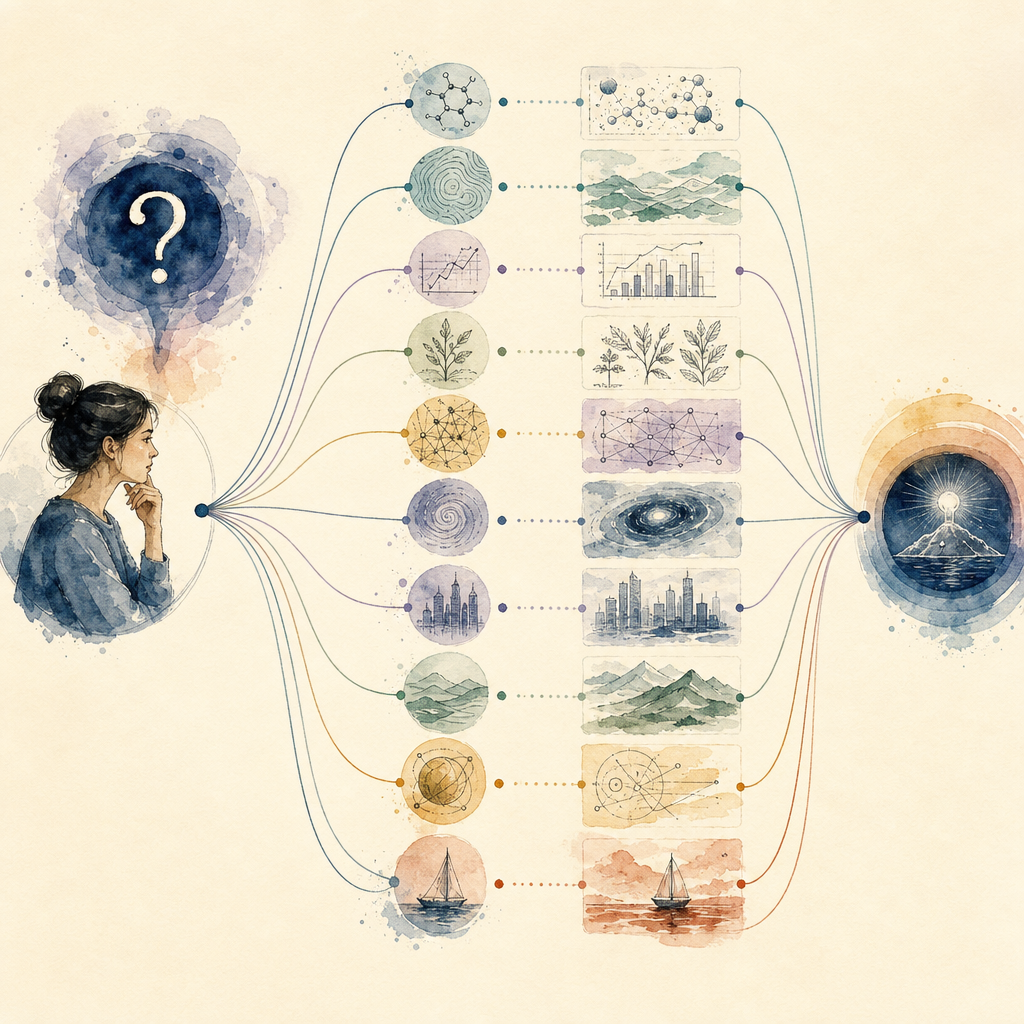
One prompt can hide a research plan
A person asks, “Which customer-data platforms work for a regulated 200-person company and support warehouse-native activation?” That is not one lookup. It contains a category, audience, scale, regulatory constraint, architecture requirement, and action. An answer system may retrieve different evidence for each part before deciding which products satisfy the combination.
Query fan-out describes this decomposition. The system can issue multiple searches, use different terms for entities and constraints, retrieve candidate passages, and synthesize the results. Vendors document pieces of search and grounding behavior, but rarely publish a complete fan-out algorithm. Use the model to design robust evidence, not to claim that a specific product always runs a fixed number of searches.
Write for the subquestion that must be verified, not only the long question a human typed.
A working fan-out map
- Entity query: what products, organizations, standards, or locations are involved?
- Constraint query: which options satisfy the audience, geography, budget, compliance, or technical requirement?
- Capability query: does the named option actually support the feature?
- Evidence query: what primary source, test, policy, or date supports that claim?
- Comparison query: how do qualifying alternatives differ?
A page that answers only “what is our product?” may be useful for the entity query and useless for the compliance query. A documentation page may satisfy the capability query but not explain audience fit. Build a content map that gives every high-value subquestion an authoritative destination, then link those destinations so both people and crawlers can discover the relationships.
Make passages independently legible
Retrieval can select a heading and its nearby text, a paragraph chunk, a table row, or a passage returned by a search index. Avoid pronouns and navigation-dependent phrases in important claims. Name the product, feature, version, geography, and condition in the passage. Put the answer before the marketing story.
A fan-out-friendly capability statement
✗ Un-optimized
“Advanced governance is available on higher plans.”
✓ Triple-rich rewrite
“Acme’s Enterprise plan supports SAML SSO and SCIM provisioning for organizations that require centralized user lifecycle management.”
The second sentence can match a query about SAML, SCIM, Enterprise, or lifecycle management. It also tells a reviewer what the claim does not say: it does not promise that every plan supports the feature.
Synthetic queries are a content diagnostic
Imagine a retrieval system rewriting “best warehouse-native attribution tool for B2B” into “B2B attribution platforms that write to a customer warehouse,” “warehouse-native attribution software,” and “does this tool require event copies?” Those variations expose gaps. If your page uses only “data-driven insights,” it may be relevant to a human but weakly aligned to the generated terms.
Do not respond by listing every synonym. Cluster equivalent concepts, choose the language your customers and documentation actually use, and define the relationship between terms. One thorough page is better than five near-duplicates. Search Console queries, support language, sales calls, and documentation tickets are stronger inputs than a thesaurus.
Design the site as a connected evidence graph
Fan-out often needs several documents to be joined. Create an explicit path from category guide to product page to technical documentation to policy or research. Use descriptive links and consistent entity names. A schema graph can reinforce Organization, Product, SoftwareApplication, Article, or Dataset relationships when those types genuinely describe visible content; markup does not replace the links and prose.
Question: Does Acme support warehouse-native activation for regulated teams?
Entity: Acme customer-data platform
Capability: warehouse-native activation
Constraint: regulated teams
Evidence: security page, warehouse docs, plan limitations
Canonical answer: /platform/warehouse-activation
Measure subquestion coverage
Add a subquestion inventory to your evaluation dataset. For every answer, label which concepts were present, which were correct, and which sources supported them. When the brand is mentioned but a competitor is cited for the critical constraint, that is not a complete win. When an answer combines unsupported facts from several pages, document the risk and improve claim-to-source alignment.
- Map one canonical passage to each important capability and limitation.
- Test entity, capability, constraint, and evidence formulations separately.
- Record citations at claim level when the interface makes that possible.
- Keep dates and versions beside volatile technical claims.
- Consolidate pages that compete for the same subquestion.
The safe optimization loop
Choose ten complex customer questions. Decompose each by hand and write the expected facts. Inspect current answers and citations. Fix the largest missing or ambiguous passage, verify crawlability, and rerun after a documented interval. Keep a control set so a product-wide retrieval change is not mistaken for a content win. This process improves answerability without pretending to control a proprietary query planner.
Decomposition is not keyword expansion
Traditional keyword expansion asks how many ways people might phrase the same term. Decomposition asks what must be known to complete the task. A buyer comparing payroll systems may need country coverage, tax-handling model, implementation effort, integration support, and contract terms. Those are distinct evidence needs even when the original prompt contains none of those words. Mapping them makes the content more useful to people and more resilient to query rewriting.
Start from the decision, then work backward. What would make the answer unsafe or useless if omitted? Which claim would a subject-matter expert verify first? Which qualification changes the recommendation? Those questions are better inputs than a list of high-volume phrases because they reveal the relationships a generated answer must preserve.
Separate retrieval breadth from answer authority
Fan-out can retrieve many candidate passages, but synthesis still needs to decide which sources deserve trust. Give each subquestion a best source and a fallback source. A product page may explain positioning; technical documentation should explain behavior; a security page should explain controls; and a contract or policy should explain obligations. Linking all of them does not make them interchangeable.
- Use the product page for audience, category, and supported use cases.
- Use documentation for configuration, limits, versions, and integration behavior.
- Use security or legal pages for certifications, processing, retention, and scope.
- Use independent research for market context and comparative claims.
- Use release notes for changes, deprecations, and effective versions.
Handle ambiguity explicitly
Synthetic queries can expose ambiguous terms. “Native” might mean data stays in a warehouse, or it might mean a vendor offers a warehouse connector. “Real time” might mean seconds, minutes, or a marketing promise. Define the term on the page and state the implementation boundary. If two meanings are legitimate, create separate sections rather than forcing one broad claim to cover both.
The same principle applies to comparisons. A question asking for the “best” tool needs criteria. Publish the criteria, explain trade-offs, and identify which segment each option serves. A transparent conditional answer is more defensible than a universal ranking that cannot be tied to evidence.
Audit the links between subquestions
A system can retrieve accurate fragments and still compose an incorrect answer if the relationships are unclear. Check that the capability belongs to the named product, the limitation belongs to the stated plan, and the certification applies to the relevant service. Repeat names in tables and captions where extraction could detach a row from its header. Treat relationship clarity as a content requirement, not a cosmetic detail.
Finally, record which subquestion caused the failure. “Brand absent” is too coarse to guide work. “Entity found, capability found, compliance evidence missing” points to a specific page and owner. Over time, these labels reveal whether your problem is discoverability, documentation depth, or unsupported positioning.
This approach also improves editorial planning. Instead of commissioning another broad article because a category term has volume, the team can publish the missing implementation note, limitation table, or evidence page that completes a known decision path. Keep the page useful to a human who arrives directly; query decomposition should produce clearer information architecture, not a collection of fragments written only for machines.
When the underlying product changes, revisit the fan-out map. New constraints create new subquestions, and retired capabilities should stop attracting current recommendations. A quarterly review of the map, paired with answer evaluations and support feedback, keeps the content aligned with how customers actually investigate a purchase.
Primary references: Google Search Central documentation on AI features; the RAG paper by Lewis et al. (NeurIPS 2020); and Microsoft’s public guidance on grounding generative AI systems. Query fan-out is used here as an implementation model; product-specific details may differ.