OpenAI Intelligent UI: What Changes for SEO, AEO, and GEO?
Interactive answers turn information into decision tools. Here is how brands can prepare without confusing a new ChatGPT experience with a new ranking system.

Rod Stockebrand
Co-founder, Brandleap.ai
Key Takeaways
Short on time? Here are the top things to know.
Article framework
How the key ideas connect
What did OpenAI announce?
What changes for discovery?
Do brands need a plugin?
Where is the early advantage?
Where should a brand start?
The most important part of OpenAI’s new announcement is not that ChatGPT can draw a prettier answer. It is that an answer can become a small piece of software: a comparison you can explore, a calculator you can change, or a form that organizes a decision. For brands, this raises a different question from “Will our page be cited?” It asks: “Can our information support what the customer is trying to do?”
On October 7, OpenAI announced GPT-6 with Intelligent UI in ChatGPT. As of this article’s October 8 publication, the announced rollout is expanding from Plus, Pro, Business, and Enterprise to Free and Go. Rollout timing and workplace settings matter; do not assume every customer sees an identical interface today.
Our recommendation: start with one customer decision and its authoritative facts. Do not start by buying an “Intelligent UI ranking” service, adding invented markup, or rebuilding the entire website as a chatbot.
What Intelligent UI actually does—and what it does not establish
OpenAI says GPT-6 can compose responses from text, visuals, and interactive elements, choosing a format that fits the question. Its examples include a bicycle diagram, a meal planner with adjustable quantities, an explanation of a statistical concept, and a bill splitter. These are examples of generated experiences, not a promise that every answer will search the web or include a brand.
The announcement describes a native, streamable component library and a compiler that processes an interface while the model generates it. That explains progressive presentation inside ChatGPT. It does not tell website owners to adopt that component library, expose their CSS, or submit an Intelligent UI feed.
- Confirmed: interactive responses in the Chat experience, with format chosen according to the task and simple text still available.
- Not established by the announcement: a new SEO score, special website schema, brand-selection algorithm, or guarantee of a citation beside each generated element.
- Not established: that an arbitrary public API, MCP endpoint, llms.txt file, or website widget is automatically discovered and invoked.
- Separate capability: OpenAI’s developer documentation describes plugins with MCP tools and optional component UI. That integration path has its own contracts, testing, permissions, and publication requirements.
The SEO/AEO/GEO implication: optimize for usable facts, not just quotable sentences
SEO still helps people and search systems discover a relevant page. AEO makes the answer and its evidence easy to extract. GEO considers how a brand is represented across generated responses. Intelligent UI potentially adds another consumption mode: those facts may need to support a decision interface, rather than a paragraph alone. That is our strategic interpretation, not OpenAI’s published ranking policy.
Consider “Which portable power station can run my refrigerator for a weekend?” A prose answer needs credible specifications. A useful calculator also needs units, usable capacity assumptions, appliance draw, conversion losses, operating conditions, and a clear distinction between continuous and surge power. A wattage claim without those relationships can produce a convincing but wrong experience.
The same applies to “Which software plan fits 12 employees?” or “Which clinic offers this consultation near me?” The decision depends on eligibility, geography, included features, dates, costs, exclusions, and uncertainty. A page that hides these behind vague marketing copy leaves both the customer and an answer system to infer them.
What remains true about traditional SEO
Keep canonical pages indexable where intended, internally linked, and readable without a fragile sequence of interactions. Put important facts in textual HTML, use meaningful headings and tables, and keep appropriate structured data consistent with visible content. Google explicitly says there are no additional technical requirements for supporting links in its AI features. That is Google’s guidance—not proof that ChatGPT uses the same eligibility rules.
For ChatGPT search access, OpenAI distinguishes OAI-SearchBot from GPTBot. Search crawling and model-training permissions are independent. Check robots rules alongside CDN and firewall behavior; an allowed crawler that encounters an access challenge still cannot reliably retrieve the page. ChatGPT-User represents certain user-initiated requests and is not the control for automatic search inclusion.
Two preparation paths: public evidence and connected capabilities
Path 1: make public information decision-ready
This is the best starting point for most brands. Identify one task and publish the facts needed to resolve it on a canonical page. Use stable product, service, location, or plan identities. Explain comparison criteria, prerequisites, limitations, and the source of each important assertion. Make it possible for a reader to check the answer rather than merely trust a summary.
- Give comparable items comparable attributes: capacity with units, price with currency and market, or service availability with location and conditions.
- State calculation formulas and assumptions in text alongside any website calculator. Include worked examples and cases where the result should not be used.
- Keep product pages, feeds, schema, support documentation, and any live data service aligned around the same entity identifiers and facts.
- Make freshness meaningful: identify when a price, policy, or specification was verified, and define who updates it when reality changes.
- Use accurate Product, Offer, Organization, or other applicable schema. Do not invent an “IntelligentUI” schema type or assume valid markup guarantees display.
Original evidence matters here. A compatibility table based on a documented test, an explicit service-area policy, or a well-maintained product catalog is more useful than another generic explainer. Consistent information from credible third parties can also help corroborate the entity and its claims. Neither your own page nor an external mention guarantees selection.
Path 2: expose a narrow, useful capability through a supported integration
If the customer task depends on live stock, account-specific eligibility, or current appointment slots, static content is not enough. Consider a supported plugin/MCP integration rather than hoping the model discovers an unregistered endpoint. OpenAI’s current developer documentation uses tools to expose data and actions, with optional UI for presenting results.
A sensible first tool might search a bounded catalog or calculate a quote estimate. Define exactly when it should run, what inputs it accepts, what it returns, and what it must never infer. A tool called “search_products” with no parameter guidance is less precise than one that documents market, budget, compatibility, and unavailable-item behavior. OpenAI explicitly advises testing tool metadata against direct, indirect, and negative prompts.
{
  "item_id": "powerstation-600",
  "canonical_url": "https://example.com/products/powerstation-600",
  "market": "AU",
  "price": { "amount": 599, "currency": "AUD" },
  "availability": "in_stock",
  "facts": {
    "capacity_wh": 600,
    "continuous_output_w": 600
  },
  "verified_at": "2026-10-08T09:00:00Z",
  "limitations": [
    "Runtime depends on load and conversion losses",
    "Stock must be rechecked before checkout"
  ]
}
The example is a design sketch for a brand’s own data contract, not an endpoint to submit to Intelligent UI. Map real fields to the documented integration you choose. Return structured facts that the model and optional component can use, and keep the server authoritative for price, stock, permissions, and saved state. A polished card displaying stale data is a failed integration.
Start read-only when possible. Separate “find available appointments” from “book an appointment,” and “estimate cost” from “charge a customer.” Consequential actions need authorization, clear confirmation, validation, and safe retry behavior. For healthcare, keep public discovery separate from clinical advice and sensitive patient data. For commerce, verify current platform eligibility and checkout restrictions before promising an in-chat purchase flow.
Why this could create an early competitive advantage
The early opportunity is operational, not magical. Many brands have the same broad content, but few have reconciled the details a decision actually depends on. A brand that can reliably answer a narrow, high-value task has a useful asset whether that information is consumed by its website, a search engine, a sales team, or an approved conversational integration.
- Data advantage: resolve conflicting specifications, prices, eligibility rules, and locations before competitors do.
- Evidence advantage: publish original, inspectable support for the decisions customers care about.
- Evaluation advantage: learn which prompts produce incorrect comparisons, missing caveats, or unsuitable tool calls, then fix the underlying cause.
- Execution advantage: offer a dependable next step when a supported integration is actually available to the user.
None of those advantages establishes an exclusive placement or durable moat. Competitors can improve their data; platform behavior can change; customers may complete more of their research without visiting your website. There is also a brand-attribution risk: your facts may be useful without your visual identity becoming the interface. Build a credible, verifiable source and a good destination, but do not assume ChatGPT will reproduce your design.
The commercial hypothesis is that a more useful decision experience can reduce friction and improve qualified outcomes. Test it. A fall in clicks alongside unchanged qualified leads means something different from a fall in both. More brand mentions with more incorrect product claims is not progress.
Where to start: a 30-day pilot with one task
Days 1–7: choose the task and establish the baseline
Use support tickets, sales conversations, and site searches to select a frequent customer decision. Favor a task with clear inputs, trustworthy data, a valuable next step, and low harm if the first version is imperfect. “Compare these three plans for my team” is usually a better pilot than “Handle everything our customers need.” Assign one product owner and one technical owner.
Create a proposed test set of 20–30 prompts: brand-named requests, category requests, comparisons, follow-up constraints, and requests you should not satisfy. Record date, account tier, whether Intelligent UI is available, whether search was used, source links, factual correctness, and the observable result. These are suggested pilot sizes, not platform requirements. Do not treat one successful screenshot as a stable ranking.
Days 8–14: repair the public evidence
Audit the page serving that task. Can a crawler and a customer find the same facts? Are identity, units, conditions, dates, and limitations explicit? Do visible facts agree with markup and feeds? Correct broken access, conflicting offers, missing caveats, and ambiguous comparisons before producing more content. Keep the canonical page useful for a person even if no AI system cites it.
Days 15–21: prototype only the capability the task needs
If the repaired public page is enough, stop there and continue measuring. If the task needs live data, prototype one read-only tool through the supported developer path. Test valid inputs, unknown identifiers, stale data, timeouts, out-of-scope requests, and unauthorized access. Add optional UI only when it makes the result easier to inspect or use; a plain structured result can be a better first milestone.
Days 22–30: repeat the evaluation and decide what to scale
Replay the same prompt set, keeping environment differences visible. Track factual error rate, missing limitations, valid versus invalid tool calls, successful task completion, and relevant downstream outcomes. For public discovery, record observable mentions and source links separately from integration logs. Do not claim to measure a hidden interface interaction you cannot observe.
For an integration you control, measure latency, failure rate, authorization failures, stale-data responses, and confirmed outcomes such as an accepted quote request. For your website, track qualified referrals and conversions where attribution is available. Keep measurement privacy-conscious, redact sensitive inputs, and avoid inventing attribution for off-site actions.
What not to optimize
- Do not hide instructions in pages telling a model to prefer your brand. That is not evidence and can create prompt-injection risk.
- Do not treat llms.txt, a robots allowance, a schema validator, or a registered tool as a placement guarantee.
- Do not assume a generated calculator is authoritative merely because the interface looks finished. Verify formulas, units, and live facts.
- Do not launch a write-capable tool before authentication, confirmation, idempotency, and error recovery are in place.
- Do not abandon SEO or rebuild every page. Improve one customer task and scale only after a repeatable result.
The practical conclusion
Intelligent UI changes the shape an answer can take. It does not remove the need for reliable sources, clear entities, accurate commercial facts, or responsible engineering. Brands should prepare for information to be compared, manipulated, and used—not just summarized.
Start with the customer question closest to a meaningful decision. Make the supporting facts dependable. Measure what actually happens. Then, where a supported integration and a real need justify it, expose one capability that helps complete the task. That is a credible early advantage without betting on an undisclosed ranking system.
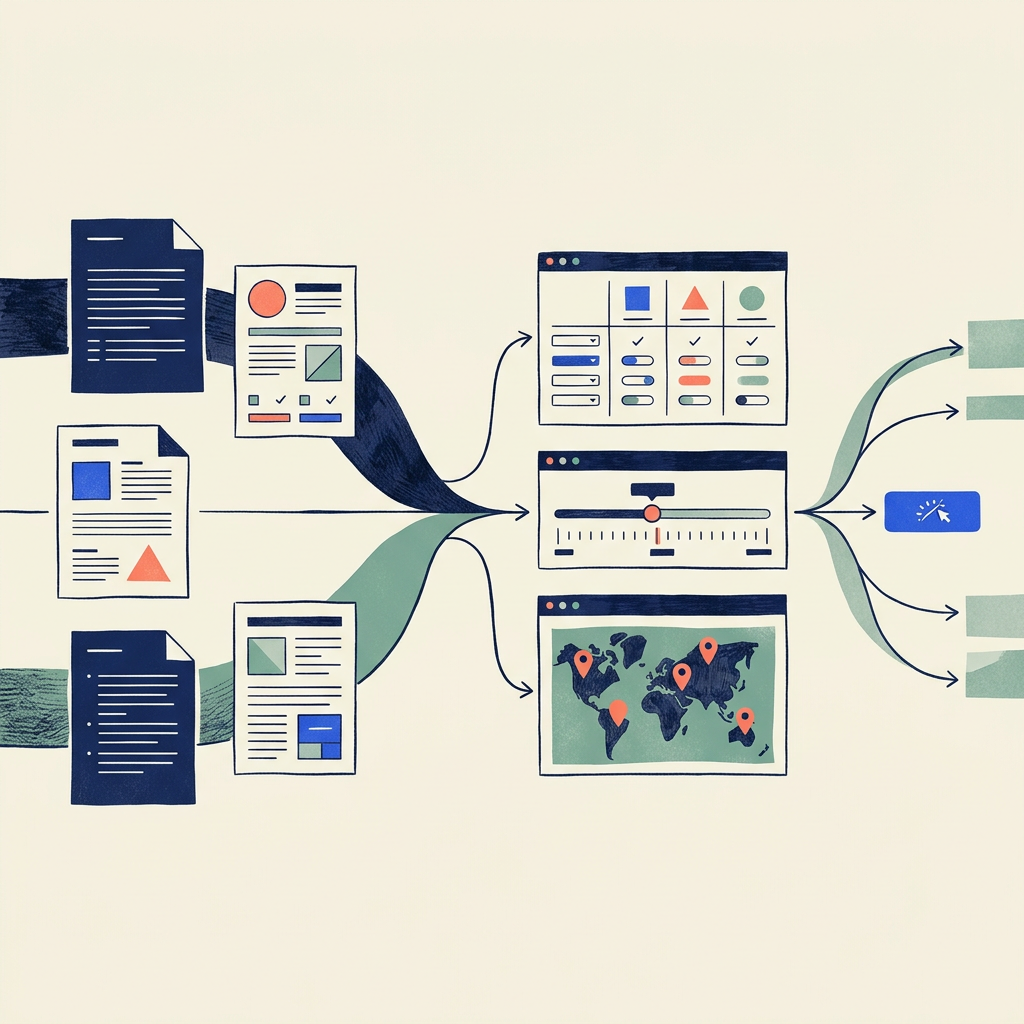
Editorial scope: product capabilities and rollout details above come from OpenAI’s announcement; integration advice comes from its separate developer documentation. The SEO/AEO/GEO implications and pilot plan are Brandleap’s analysis as of October 8, 2026, not OpenAI ranking guidance or a guarantee of results. Hero artwork is conceptual, not a ChatGPT screenshot.