Latest Issue
Tools.
Things worth trying
- ChatGPT Business Hub: manage the facts behind discovery(opens in a new tab)
Published
Claim and verify an eligible business, correct its details, and add a self-service product feed with current prices and availability. Then inspect aggregated mentions, website clicks, and discovery topics where thresholds are met. The edge is first-party platform feedback, not an estimated visibility score. Beta launched November 10; no raw user conversations or guaranteed recommendations.
- Business Agents: test the handoff after an AI recommendation(opens in a new tab)
Published
Eligible US ecommerce and online service businesses can build and test a clearly labeled agent for their ChatGPT profile. Use a fixed set of pricing, fit, and policy questions to check factual accuracy and website handoffs before launch. This is a business-owned conversation, separate from ChatGPT’s independent answer—not a shortcut to organic citations. Part of the same November 10 launch.
- Google Search: inspect Hydrogen’s new answer behavior(opens in a new tab)
Published
Google’s November 12 Gemini 4 Hydrogen upgrade changes query fan-out, links, and visual answers. Re-run an unchanged panel of multi-constraint buyer questions in AI Mode; save cited URLs and which constraints each answer satisfies. Compare with your pre-update captures to find coverage changes. This tests the live search experience—not an API exposing Google’s hidden subqueries or a causal ranking test.
- CrUX: see FCP and navigation types with soft navigations(opens in a new tab)
Published
The November 11 update adds FCP and Navigation Types including soft navigations to CrUX APIs and CrUX Vis. For a JavaScript-heavy site, compare the new field-data views with existing metrics before declaring a performance win or regression. This helps separate a changed measurement boundary from faster pages. These additions reach BigQuery next month; experimental metrics are not a new ranking signal.
- Cloudflare Kitesurf: add an experimental rendering comparison(opens in a new tab)
Published
Newly open-sourced November 12, Kitesurf parses HTML, runs JavaScript, and captures screenshots through CDP. Developers can compare representative templates with Chrome, flagging missing content, headings, or links for investigation. The value is reproducible page evidence, not generic AI advice. Standards support is experimental: confirm every failure in Chrome; this does not reproduce an AI crawler.
Bonus · From Brandleap
Bonus: Brandleap’s free AI Visibility Report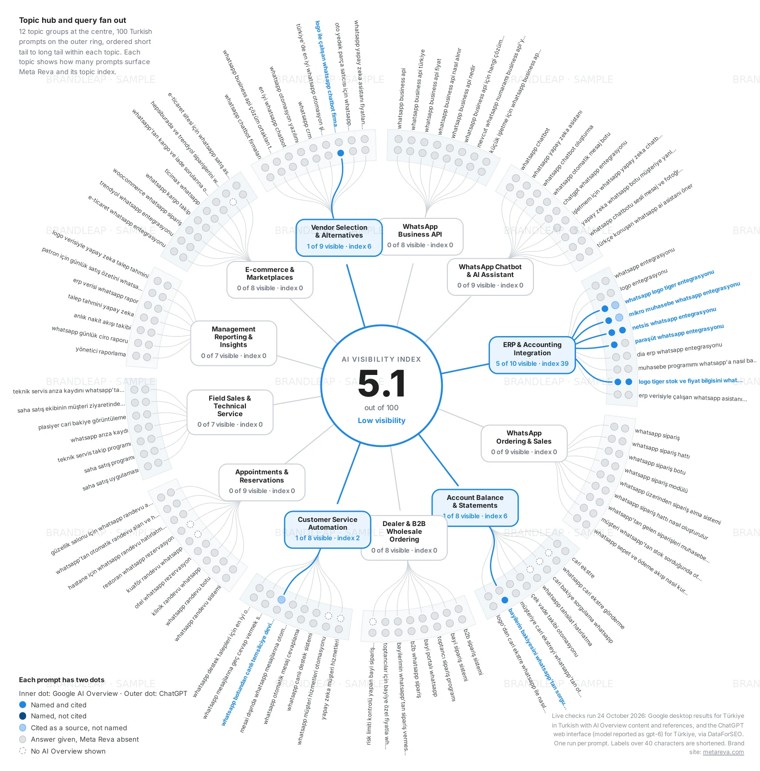
See whether Google AI Overviews and ChatGPT mention your brand or cite your website. Request a human-reviewed AI Visibility Index PDF with an evidence CSV, and use the topic wheel to identify coverage gaps worth investigating.
Grab a free AI Visibility Report here
Tactics.
Ideas to put to work
- Test LinkedIn formats by engine, not by total reach(opens in a new tab)
Published
Use a matched-topic pilot across personal/company Pulse articles and posts; track citations per URL separately by engine for 30+ days. OtterlyAI’s November 9 study earned 107 citations, 99.1% from Copilot and Perplexity; none from ChatGPT during its window. Match effort and topic difficulty, and measure qualified referrals too. A one-team observational result is a hypothesis—not a universal Pulse advantage.
- Rebuild your click-opportunity model from current GSC cohorts(opens in a new tab)
Published
iPullRank’s November 12 analysis spans 166 brands and finds old position-to-click curves overstate current traffic. Fit your own recent nonbrand CTR baseline by device, country, and intent; estimate incremental clicks for near-top queries instead of rewarding every one-position gain equally. Test title changes against matched controls after the core rollout settles. Observational click/rank timing does not prove causation.
- Build a referrer reconciliation test—not an AI traffic guess(opens in a new tab)
Published
Google’s new November 12 guide specifies web, local-domain, and Android-app referrers. Classify landing-page requests only; separate asset loads, paid clicks, and redirect losses, then reconcile daily trends with GSC and consented analytics. Flag gaps rather than forcing totals to match. Google-origin referrers can include Discover or Images and cannot isolate AI Mode, AI Overviews, or the original query.
- Audit where AI sends shoppers—not just whether it names you(opens in a new tab)
Published
Podqi’s newly reported 6,795-answer study found risky destinations across three engines. Test regional-store and where-to-buy prompts for your brand; classify every destination as owned, authorized, unknown, or dead, with screenshots and timestamps. Publish an accurate official-sites list and route suspected impersonation to your security/legal team. Re-test the same panel; do not assume one content change fixes retrieval.
- Separate paid, organic, and agent-owned AI appearances(opens in a new tab)
Published
Seer’s November 12 review of 161 recorded sessions found sponsored cards on branded prompts, often unnoticed by users. Run the same buyer questions on permitted free/logged-out and paid accounts; annotate sponsored units, independent mentions, sources, and Business Agent handoffs separately. Compare qualified clicks—not a blended visibility score. Small, uneven usability samples cannot establish market-wide ad rates.
Resources.
Reading worth your time
- Google’s November core update: the primary status record(opens in a new tab)
Published
The rollout began November 10 and may take up to two weeks. Use Google’s incident record to date your analysis window and distinguish confirmed status from speculation. Save a baseline now; don’t label a mid-rollout change a final outcome or attribute it to one site edit. This is the live official record, not a recovery checklist.
- GSC’s November 9–11 AI impressions anomaly(opens in a new tab)
Published
Google confirms a logging error reduced reported impressions in Generative AI in Search for November 9–11. Annotate that window in reports and experiments before interpreting an apparent AI visibility loss alongside the core update. The notice concerns data logging, not an actual performance decline; do not assume missing counts have been restored unless Google confirms it.
- 5.5 million ChatGPT answers—and the denominator that matters(opens in a new tab)
Published
Ahrefs’ November 11 brand-mention snapshot explains its aliases, exclusions, and all-topic US denominator. Use the methodology to audit your own mention counting and distinguish answer share from category share, citations, or sentiment. It is a vendor-index snapshot of 5,516,381 answers—not OpenAI’s complete conversation population or a recipe for earning mentions.
- AI traffic quality: compare economics, not headline multipliers(opens in a new tab)
Published
This November 12 guide separates visibility, identifiable referrals, conversion events, and revenue per visit. Use its comparison framework to inspect source/medium gaps and compare similar landing pages and buying journeys. Studies use different samples and dates; a headline conversion advantage from another site is not your forecast, and untracked AI influence is not measurable referral revenue.
- ChatGPT’s information sources: a diagnostic reading guide(opens in a new tab)
Published
Ahrefs’ November 10 explainer separates training data, live search, licensed publisher content, and user-provided context. Use it to ask which information path you are actually testing before prescribing a crawl or content fix. This is a new synthesis, not a newly launched search capability; it does not let you identify the provenance of every unsourced answer.