WTF Is Liquid Content?
And why content that can't survive being poured out of your page will never get quoted by an answer engine

Rod Stockebrand
Co-founder, Brandleap.ai
Key Takeaways
Short on time? Here are the top things to know.
Article framework
How the key ideas connect
What is liquid content?
Where does the term "liquid content" come from?
Why does liquid content matter for AEO?
How do you make content liquid?
What tools and models support liquid content?
WTF is liquid content, actually?
The word "liquid" entered the content vocabulary in 2011, when Coca-Cola published its Content 2020 strategy and declared that the future belonged to "liquid and linked" ideas — content fluid enough to flow across any channel, but linked tightly enough to stay unmistakably Coke. It was a marketing thesis about virality, and honestly, most people filed it under "big brand says inspiring thing" and moved on.
Then the machinery of the web caught up with the metaphor. Publishers and CMS vendors rebuilt it as an operating model: stop treating the page as the unit of content, and start treating the atomic unit — a definition, a price, a step, a stat — as the thing you create, maintain, and reuse. One authoritative version of each unit, assembled into whatever surface needs it, with updates flowing from a single source of truth. NPR got there early with COPE — Create Once, Publish Everywhere, the philosophy that powered its API-first newsroom.
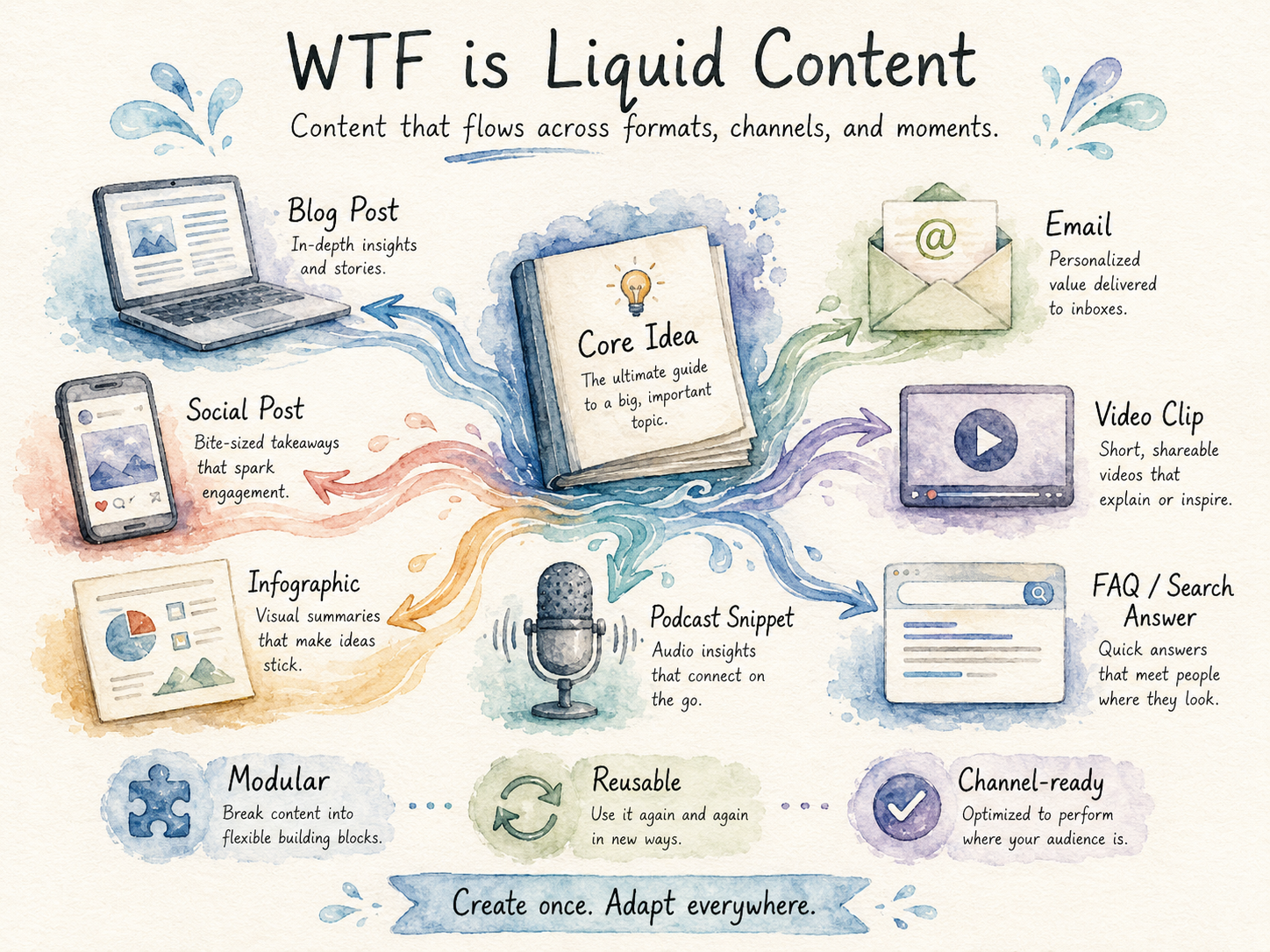
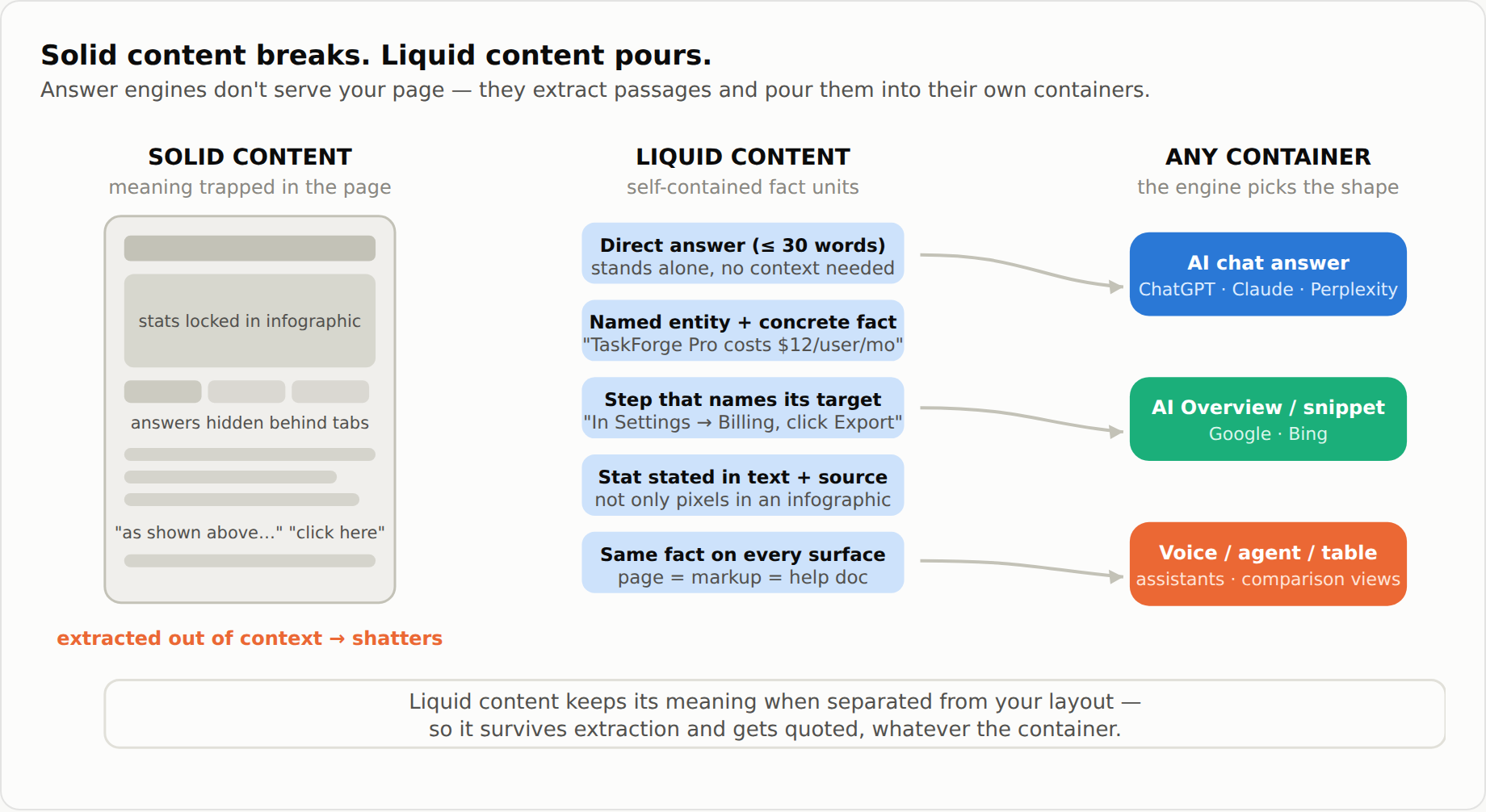
So here's my working definition: liquid content is content that keeps its meaning when it's poured out of your page. Every important unit stands alone — no tab to click, no image to squint at, no "as we mentioned above" to chase. Solid content is the opposite: meaning welded to a specific layout, in a specific order, on a specific screen.
Why answer engines just made this urgent
If you read my last piece on semantic triples, here's how the two ideas stack: triples are the atoms — single extractable facts. Liquid content is the molecule level — whole passages engineered to travel. And travel is the whole game now, because the page has quietly stopped being the unit of consumption.
When someone asks ChatGPT, Perplexity, or Google's AI Overview a question, the engine retrieves your page, chops it into passages, and pours the useful ones into its own container — a chat bubble, a cited summary, a voice reply, a comparison table an agent builds on the fly. Your fonts don't make the trip. Your carefully designed tabs don't make the trip. Only the text makes the trip — and only if it still means something when it lands.
There's a second, uglier reason this matters: many AI crawlers don't execute JavaScript well — or at all. If your FAQ lives in a client-rendered accordion or your pricing appears only after a calculator runs, some engines literally receive an empty div where your best answers should be. Solid content isn't just hard to quote; sometimes it's invisible.
Solid vs. liquid: four page patterns, rewritten
Same drill as last time — patterns you'll recognize from real sites everywhere, with the solid version on the left and the liquid rewrite on the right. Ask yourself of each: if an engine grabbed one passage and threw the rest away, what would survive?
Example 1 — Pricing trapped in a widget
✗ Un-optimized
"See our flexible plans! Use the slider below to build your perfect package, and toggle between monthly and annual billing to see your savings. Questions? Chat with sales!" (All actual prices live inside an interactive calculator that renders client-side.)
✓ Triple-rich rewrite
"TaskForge offers three plans. The Free plan supports up to 5 users. The Pro plan costs $12 per user per month billed annually, or $15 billed monthly. The Enterprise plan starts at $30 per user per month and adds SSO, audit logs, and a dedicated support manager."
The widget version has zero extractable prices — and if the crawler doesn't run your JavaScript, zero content at all. The liquid version answers "how much does TaskForge cost" in any container, including a voice reply.
Example 2 — The how-to step that points at the layout
✗ Un-optimized
"Next, click the icon shown above and repeat the same steps from the previous section. Once you've done that, you'll see the option you need on the right-hand side of the screen."
✓ Triple-rich rewrite
"To export your TaskForge billing history, open Settings → Billing and click Export CSV. TaskForge generates a file containing every invoice from the past 24 months. Exports are available on the Pro and Enterprise plans."
"Shown above" and "the previous section" are meaningless once the passage leaves the page — the step dissolves. The liquid step names the product, the path, the action, and the result, so it works as a standalone answer.
Example 3 — The stat locked in an infographic
✗ Un-optimized
"Onboarding is broken — and the numbers prove it. Check out our State of Onboarding infographic below to see just how much churn bad first-weeks cause!" (Every number exists only as pixels inside a 1200×3000 PNG.)
✓ Triple-rich rewrite
"According to TaskForge's 2026 State of Onboarding survey of 1,200 SaaS companies, 43% of customer churn happens in the first 30 days, and companies with guided onboarding retain 2.1× more users at day 90. The full dataset is available below the summary."
Engines can increasingly read images — but a stat stated in text, with its source, sample size, and year attached, is the version that gets extracted, attributed, and cited. The infographic becomes the illustration, not the only copy of the fact.
Example 4 — The FAQ that only exists after JavaScript runs
✗ Un-optimized
<div id="faq-app"></div><script src="/faq-widget.js"></script> (Questions and answers are fetched and rendered client-side inside a collapsed accordion.)
✓ Triple-rich rewrite
"Does TaskForge integrate with GitHub? Yes. TaskForge's GitHub integration links pull requests to tasks automatically and is included in every plan, including Free." (Rendered as real text in the HTML, mirrored with FAQPage schema markup.)
The left version ships an empty div to any crawler that doesn't execute JS. The right version is a complete question-and-answer pair in the HTML itself — the exact shape answer engines lift — with markup reinforcing it.
The operating model behind it
Writing liquid passages is half the job; keeping them liquid is the other half. The moment the same price lives in five places — homepage, pricing page, help doc, schema markup, sales PDF — it will eventually disagree with itself, and an engine that finds two versions of a fact trusts neither. That's why the CMS side of this matters: structured content platforms like Contentful, Sanity, and Contentstack store each unit once and assemble it everywhere it appears, so an update propagates instead of scattering. That's the single-source-of-truth discipline COPE preached and the liquid content model formalizes.
And once your facts are atomic and consistent, mirroring them for machines is nearly free: the same units map cleanly onto Schema.org JSON-LD (validate with the Rich Results Test), and if you want to go further, the llms.txt proposal gives AI crawlers a clean, markdown version of your key content with all the layout already removed — liquid content in its purest form.
Handy resources to go deeper
- Coca-Cola's Content 2020 — the origin of "liquid and linked" content strategy
- NPR's COPE (Create Once, Publish Everywhere) — the API-first newsroom model
- Contentful, Sanity, Contentstack — structured, headless CMSs for atomic content storage
- Schema.org — vocabulary reference for JSON-LD structured data
- Rich Results Test — validate your structured data before shipping
- llmstxt.org — the llms.txt proposal for AI-crawler-friendly content
- Contentstack's answer-engine optimization guide, Profound's AEO explainer, Frase's AEO guide
Your challenge
No conclusion. You know how this series works by now — you get homework.
This one's called the pour test. Go to your most valuable page, copy one paragraph — just one, no headline, no context — and paste it into a blank ChatGPT or Claude chat with the question: "What would you learn from this passage alone?" If the answer is "someone is passionate about something, unclear who or what," that paragraph is solid, and it will never be quoted anywhere.
Then do the machine's version of the test: turn off JavaScript in your browser and reload the page. Whatever disappeared — pricing, FAQs, specs — is content some AI crawlers have never seen. Rewrite one section this week so it stands alone as real text: named subject, direct answer, concrete numbers. Pour it into a chat again and watch it hold its shape.
Because that's the whole game now. WTF is liquid content? It's content that's still true, still clear, and still yours — in whatever glass it ends up in.
Business names, copy samples, and statistics in the before/after examples are illustrative composites of common page patterns, not quotes or data from actual companies. All linked resources are third-party sites; no affiliation.