WTF Are Semantic Triples?
And why the sentences you write today decide whether AI answer engines quote you tomorrow

Rod Stockebrand
Co-founder, Brandleap.ai
Key Takeaways
Short on time? Here are the top things to know.
Article framework
How the key ideas connect
What is a semantic triple?
Why do semantic triples matter for AEO?
How do you write triple-rich content?
Do semantic triples require schema markup?
Which tools help with semantic triples and AEO?
WTF is a semantic triple, actually?
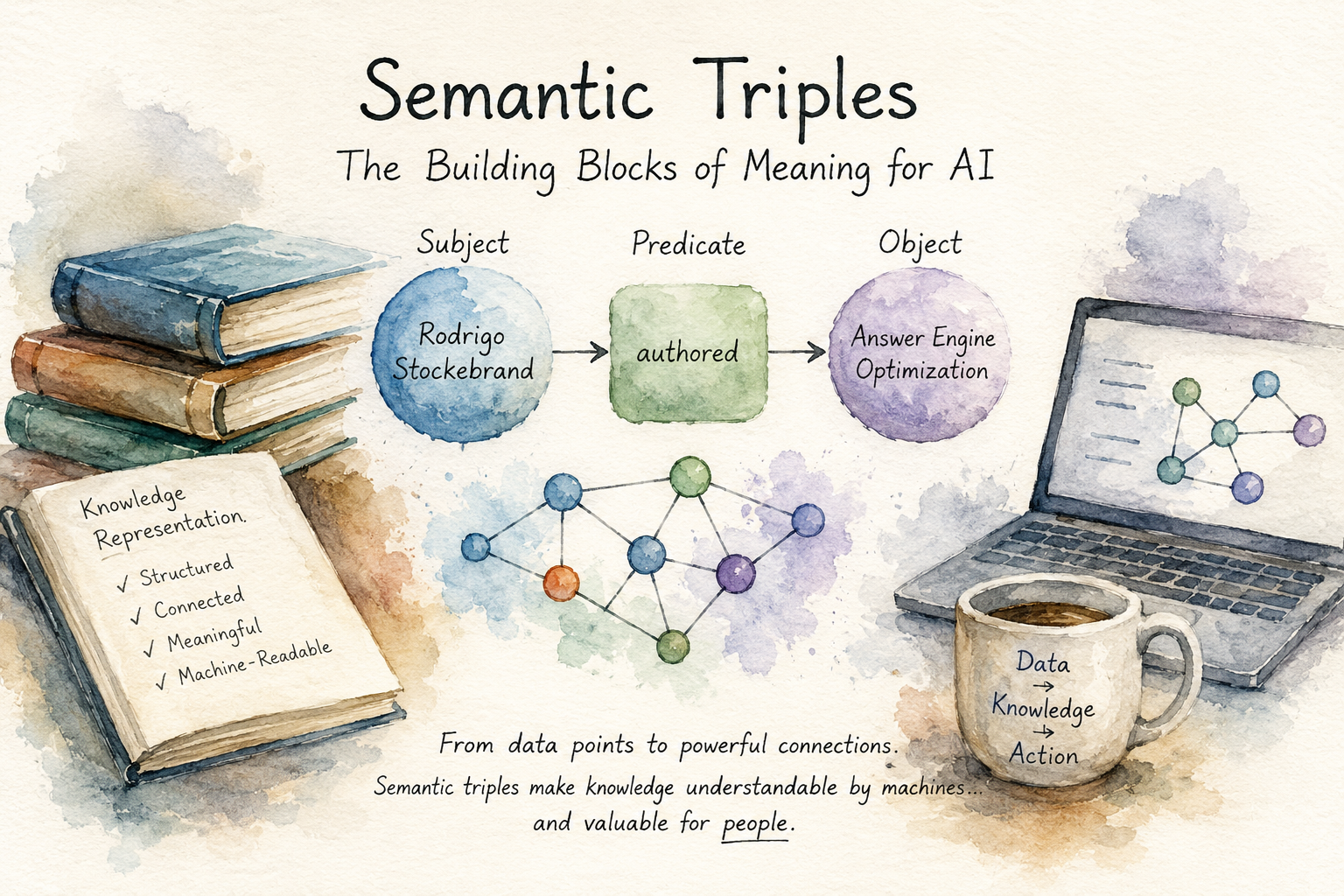
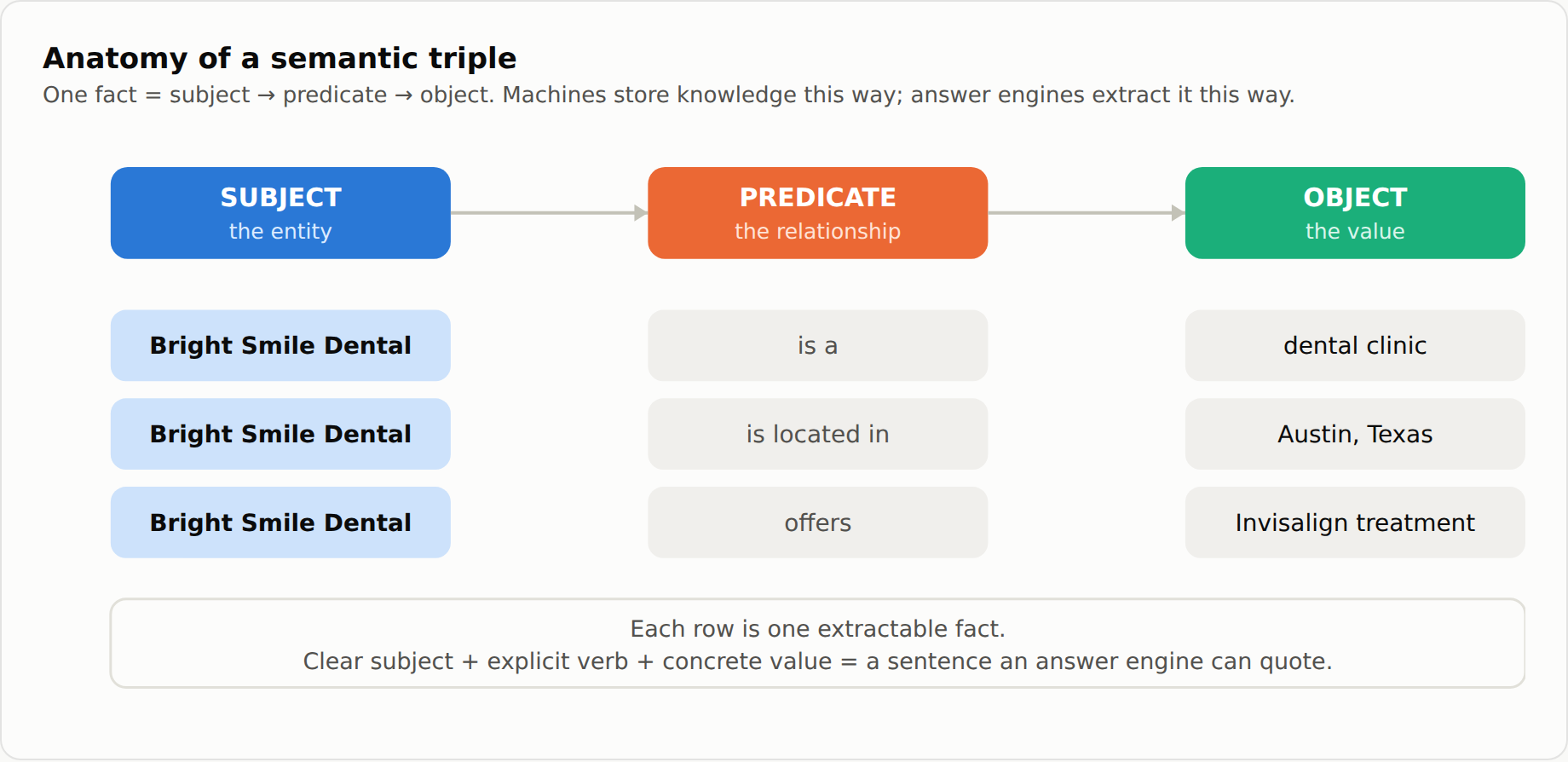
Strip away the jargon and a semantic triple is just a fact with three parts: a subject (the thing you're talking about), a predicate (the relationship), and an object (the value). "Paris is the capital of France." Subject, predicate, object. Done. You've been writing triples since third grade — you just stopped when you learned marketing.
This isn't an SEO gimmick; it's how the machine half of the web stores knowledge. The W3C formalized it decades ago as RDF, the Resource Description Framework, and it's the atomic unit of every knowledge graph you've ever benefited from. Wikidata is over a hundred million entities connected by billions of triples. Google built its Knowledge Graph on the same idea — their classic framing was "things, not strings": stop matching keywords, start connecting entities.
Why answer engines think in triples
Here's the shift that makes this urgent. Search engines ranked pages; answer engines extract facts. When someone asks ChatGPT, Perplexity, or Google's AI Overview "how much does X cost" or "who does Y serve," the engine isn't sending traffic to ten blue links — it's pulling sentences out of pages, checking them against each other, and quoting the ones it trusts. A sentence that reads as a clean triple is cheap to extract and easy to verify. A paragraph of vibes is neither.
You can see this in who wins citations today. Wikipedia opens every article with a dense stack of triples — "Paris is the capital and largest city of France" hands you entity, type, superlative, and parent entity in eleven words. Cloudflare's Learning Center starts every page with "What is a CDN? A CDN is a geographically distributed group of servers…" — question, then definitional triple, immediately. Investopedia does the same for every financial term. These sites get cited constantly by AI engines, and it's not an accident — their house style is basically triple manufacturing.
Now compare that to the average business homepage: "We're passionate about delivering innovative solutions that delight our customers." Who is? Delivering what? To whom? For how much? There is not one extractable fact in that sentence. To an answer engine, it's empty air.
Before and after: real-world page types, rewritten
Let's make this concrete. Below are four page types you'll recognize from every corner of the web, with the copy pattern they typically use — and what a triple-rich rewrite looks like. Read the right-hand column and count the facts you could pull out with a highlighter.
Example 1 — The local business homepage
✗ Un-optimized
"Welcome to our practice! For over two decades, our caring team has been proudly serving families throughout the metro area with a gentle touch and a commitment to excellence. Your smile is our passion!"
✓ Triple-rich rewrite
"Bright Smile Dental is a family dental clinic in Austin, Texas, founded in 2003. The clinic offers teeth cleaning, Invisalign, dental implants, and emergency dental care. Bright Smile Dental serves the Mueller, Hyde Park, and Cherrywood neighborhoods, and is open Monday–Friday, 8 a.m.–5 p.m."
The before version has zero extractable facts — not even the business name. The after version yields at least eight triples: what it is, where it is, when it was founded, four services, three neighborhoods, and its hours. When someone asks an assistant "Invisalign dentist near Hyde Park, Austin," only one of these pages can be the answer.
Example 2 — The SaaS product page
✗ Un-optimized
"Supercharge your workflow with our next-generation platform. Seamless collaboration meets powerful automation, so your team can focus on what matters most. Loved by thousands of forward-thinking teams."
✓ Triple-rich rewrite
"TaskForge is project management software for engineering teams of 10–200 people. TaskForge's Pro plan costs $12 per user per month and includes Gantt charts, sprint planning, and GitHub integration. TaskForge was founded in 2019 and is used by more than 4,000 companies."
"Supercharge your workflow" answers nothing anyone asks. The rewrite answers the four questions buyers actually put to AI assistants: what is it, who is it for, what does it cost, what does it include.
Example 3 — The e-commerce product description
✗ Un-optimized
"You'll reach for this cozy classic again and again. Effortlessly versatile and impossibly soft, it's the perfect addition to any wardrobe. Elevated basics, redefined."
✓ Triple-rich rewrite
"The Fieldstone Crew is a men's crewneck sweater made from 100% merino wool, knit in Portugal. It weighs 340 grams, comes in six colors, and is machine washable on cold. The Fieldstone Crew costs $98 and ships free in the US."
Shopping assistants compare products on material, origin, care, price, and shipping. "Impossibly soft" doesn't survive extraction; "100% merino wool, machine washable, $98" does.
Example 4 — The "What is X?" explainer
✗ Un-optimized
"In today's fast-paced digital landscape, businesses are increasingly turning to innovative technologies to stay ahead of the curve. One such technology that has been generating buzz is edge computing, which promises to revolutionize the way we think about data."
✓ Triple-rich rewrite
"Edge computing is a computing model that processes data near where it is generated — on local devices or nearby servers — instead of in a distant centralized data center. Edge computing reduces latency, cuts bandwidth costs, and keeps sensitive data local. Common uses include self-driving cars, smart factories, and video streaming."
The before version is the infamous "in today's fast-paced world" throat-clearing — 40 words before the topic even appears. The rewrite is the Cloudflare/Investopedia pattern: define the entity in sentence one, benefits in sentence two, examples in sentence three. That first sentence is the exact shape AI Overviews and chat assistants lift verbatim.
Level up: say it in markup too
Once your prose carries the triples, mirror them in structured data. Schema.org is the shared vocabulary, and Google's structured data documentation explains how search features consume it. The format you want is JSON-LD — and if you look closely, it's just triples wearing a JSON costume. Here's Bright Smile Dental again:
{
  "@context": "https://schema.org",
  "@type": "Dentist",           // subject is-a object
  "name": "Bright Smile Dental",
  "foundingDate": "2003",       // subject founded-in 2003
  "address": {
    "@type": "PostalAddress",
    "addressLocality": "Austin", // subject located-in Austin
    "addressRegion": "TX"
  },
  "availableService": ["Teeth cleaning", "Invisalign", "Dental implants"],
  "openingHours": "Mo-Fr 08:00-17:00"
}
Every property line above is a predicate; every value is an object; the entity at the top is the subject. Same facts, machine-native format. Validate what you ship with the Schema Markup Validator (checks your Schema.org syntax) and the Rich Results Test (checks what Google will actually do with it).
One warning from the trenches: your markup and your prose must agree. If the page says "$12 per user" and the markup says "$10," you've taught the machine to distrust both.
Handy resources to go deeper
- W3C RDF Primer — the canonical explanation of triples
- Wikidata — browse any entity to make the concept click in 90 seconds
- Schema.org — full type hierarchy and vocabulary reference
- Merkle Schema Markup Generator — generate starter JSON-LD markup
- Schema Markup Validator & Rich Results Test — validate before you ship
- InLinks / WordLift — automate entity detection and knowledge-graph markup at scale
- Screaming Frog — audit structured data across every URL you own
Your challenge
No tidy conclusion — you know the drill by now. Here's the homework instead.
Open the most important page on your site. Take a highlighter — a real one or the mental kind — and mark every sentence a stranger could quote as a standalone fact: named subject, explicit verb, concrete value. Most pages I run this on score two or three highlights out of thirty sentences.
Then pick the worst paragraph and rewrite it the way we rewrote Bright Smile Dental: name the entity, state what it is, where it is, what it offers, what it costs. Ship it, mirror it in JSON-LD, validate it, and then ask ChatGPT and Perplexity a question your customers actually ask. Watch who gets cited.
If it's still not you in a month, run the highlighter test again — I'd bet the pages beating you are just better at saying who they are. WTF are semantic triples? They're the difference between being on the web and being in the answer.
Business names and copy examples are illustrative composites of common page patterns, not quotes from actual companies. All linked resources are third-party sites; no affiliation.