Multilingual AEO: Locale URLs, Hreflang, and AI Search
A practical framework for making regionally accurate answers discoverable, attributable, and testable across languages and markets

Rod Stockebrand
Co-founder, Brandleap.ai

Key Takeaways
Short on time? Here are the top things to know.
Article framework
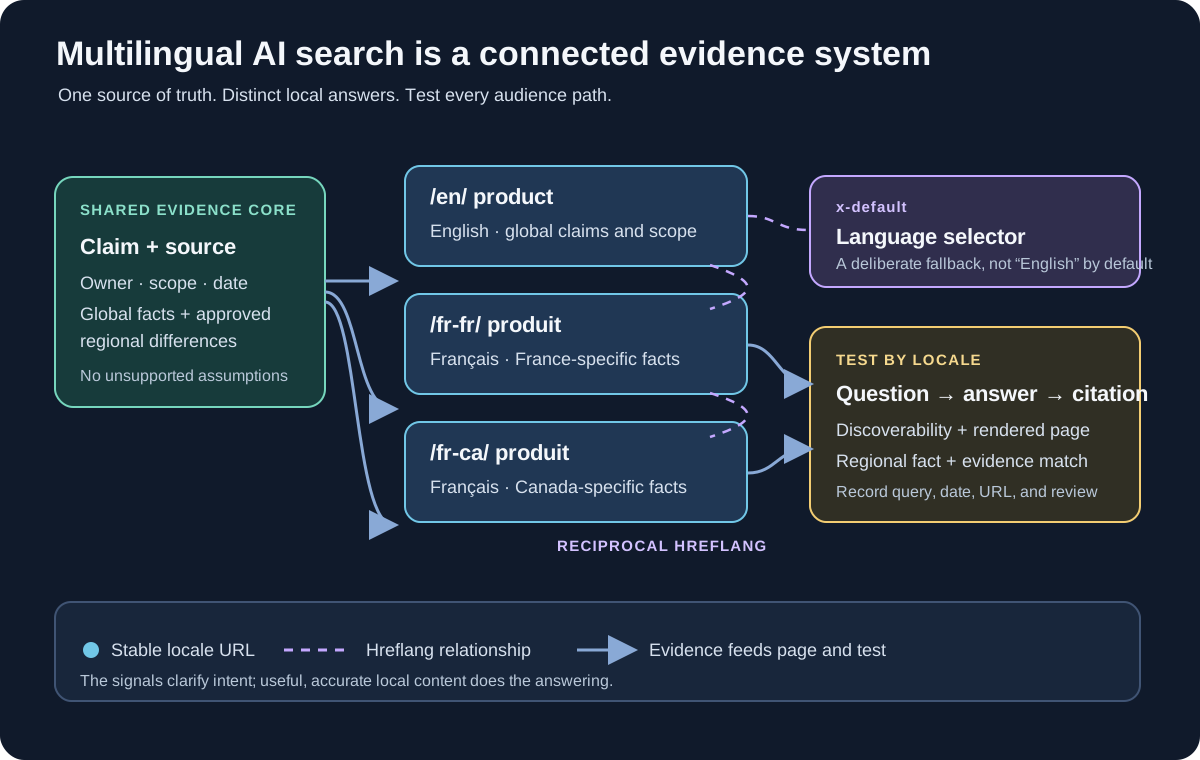
How the key ideas connect
Do AI search systems need separate URLs for each language?
What do hreflang and x-default actually do?
Is translation enough for multilingual AEO?
How can a team keep regional pages factually consistent?
How should multilingual AI visibility be tested?
A language switch does not create international answer coverage
A company can translate its homepage into five languages and still provide a poor answer to a customer in any of them. Maybe a French page describes a product that is not sold in France. Maybe the German version quotes a price in dollars. Maybe the English page is the only one with a current warranty, limitation, or source citation. These are not cosmetic defects: they change what the answer means and whether it applies.
Multilingual answer engine optimization (AEO) is the work of making trustworthy, locally appropriate answers discoverable in the languages and markets a business serves. AI search adds a practical reason to be precise: systems need to discover a page, interpret its intended audience, retrieve the relevant passage, and cite a source that supports the answer. No hreflang tag or translation workflow guarantees that chain. The goal is to remove preventable ambiguity and test the result.
Think of every market page as an answer contract: who it serves, what is true there, which evidence supports the claim, and when that evidence should be reviewed.
Start with the audience, not a country-code domain
A language and a market are related but not interchangeable. Spanish-language visitors may be in Spain, Mexico, the United States, or elsewhere; their questions and the relevant policies may differ. Conversely, one market may use multiple languages. Decide which audience differences deserve their own version before choosing URL structure. A page should represent a meaningful language or market experience, not exist only to multiply URLs.
For most teams, a consistent subdirectory pattern is operationally straightforward: /en/, /fr-fr/, /fr-ca/, or /de-de/. Subdomains and country-code domains are also possible. The trade-offs involve ownership, hosting, analytics, migration, and market strategy; none is a universal AI-search ranking shortcut. Prefer stable, directly crawlable URLs that work without a visitor first setting a cookie or accepting a browser-language redirect.
- Give each materially distinct language or regional experience its own persistent URL.
- Link versions with a visible language or region selector, using ordinary links that work without client-side state.
- Keep language and region signals consistent in the URL, page content, navigation, and metadata.
- Avoid forcing every visitor to one version based only on IP address or browser preference; make alternate versions discoverable.
- Use a self-referencing canonical for an independently useful locale page unless there is a specific, justified canonicalization plan.
Hreflang describes relationships; it is not a translation signal
Hreflang annotations tell Google that a set of URLs are alternate versions intended for different languages or language-region audiences. They can be expressed in HTML link elements, HTTP headers, or XML sitemaps. For a small site, HTML is often easiest to inspect; for a large international catalog, a sitemap may be easier to generate and validate. Choose one maintainable source of truth rather than letting CMS templates and hand-edited tags drift apart.
Every member of a cluster should identify itself and the other equivalents. Use valid language or language-region tags, ensure URLs resolve, and ensure each target is a genuine alternative rather than a generic homepage or unrelated page. If one version is missing reciprocal annotations, the relationship becomes less dependable. Hreflang helps express the intended mapping; it does not repair thin, stale, or contradictory localized content.
Use x-default for the fallback destination when a visitor does not match one of the listed language-region alternatives—for example, a language selector or a genuinely neutral global page. It is not shorthand for English and should not be attached to every page by default. If English is the intended fallback, the English URL may serve that purpose when it is truly a reasonable default; make the choice explicit.
<link rel="alternate" hreflang="en" href="https://example.com/en/product/" />
<link rel="alternate" hreflang="fr-FR" href="https://example.com/fr-fr/produit/" />
<link rel="alternate" hreflang="fr-CA" href="https://example.com/fr-ca/produit/" />
<link rel="alternate" hreflang="x-default" href="https://example.com/language/" />
<link rel="canonical" href="https://example.com/fr-fr/produit/" />
This illustrative fragment belongs on each equivalent page, with the same set of alternates and a self-reference for that page’s canonical URL. It does not imply that all pages should canonicalize to English. Before deployment, validate every URL, status, canonical target, locale code, and reciprocal relationship against the actual page inventory.
International signals work together, not in place of content
✗ Un-optimized
A translated page sends every locale to /en/ and points its canonical there; hreflang names URLs that redirect.
✓ Triple-rich rewrite
A stable, useful locale page is crawlable, self-canonical where appropriate, linked to equivalent versions, and accurate for its intended audience.
Translation preserves meaning; localization preserves usefulness
Translation aims to convey the source meaning in another language. Localization asks whether the answer works in the local context. It may change terminology, examples, units, date and number formats, currency, legal qualifications, support details, product availability, and the sources a reader can act on. Localizing is not license to make unsupported claims; the adaptation needs an editor who understands both the language and the market.
Consider a service page stating, “Available across the United States; plans start at $X per month.” A literal French translation on a Canadian URL would not establish availability in Canada, would preserve a potentially misleading currency, and might omit applicable terms. The proper localized page either verifies and states the Canadian offer with Canadian evidence or clearly says the service is not available there. Unknown is not the same as translated.
- Keep global facts stable: company identity, product principles, and claims that truly apply across markets.
- Localize conditional facts: price, currency, shipping, service area, tax, eligibility, support hours, and legal terms.
- Use local names and vocabulary only when they accurately describe the same entity, product, or process.
- Preserve qualifications, dates, denominators, and limitations when translating evidence or research findings.
- Mark unavailable, unverified, or market-restricted information plainly instead of filling gaps with a global default.
Build factual parity without forcing identical pages
Factual parity means a person asking an equivalent question in another locale can find an answer that is no less complete, current, or supportable. It does not mean a word-for-word clone or identical commercial terms. A country-specific warranty can legitimately differ; the regional page should state its own terms and link to the relevant authority. A global product description should not quietly gain different capabilities in translation.
Govern content as shared claims with regional attributes. A record for a claim can include its wording, source, applicable markets, owner, last-reviewed date, and expiry or review trigger. Local editors can then adapt the presentation while legal, product, or support owners approve facts within their remit. When a source changes, the system should reveal which locale pages depend on it.
Claim: Product support is available
Global wording: Support is available on business days.
Market facts: [market] | [local hours and time zone] | [language]
Evidence: [official support policy URL]
Owner: [regional support owner] | Reviewed: [date]
If unknown: State that availability is unconfirmed; do not infer it.
Citations deserve the same care as claims. Prefer sources authoritative for the particular fact: a local regulator for a legal requirement, a regional product or support page for availability, and the original research or its localized methodology for a statistic. If a translated page cites a source in another language, describe the source accurately and, where practical, link to both the original and an official translation. Do not present a machine-translated source as an official localized edition.
Make citations useful in every locale
A citation should resolve to evidence that supports the sentence beside it. Prefer a stable, public URL over a temporary session link; identify the organization, publication date, and scope in readable text. For claims with a regional boundary, make that boundary visible next to the claim rather than leaving a reader to infer it from a distant footer or country selector.
A useful pattern is to publish the localized explanation in HTML and cite the primary evidence directly, while also retaining an original-language citation when translation could obscure meaning. A translated page does not need a translated version of every authority to be credible. It does need to explain which language the source uses and what the source actually establishes. AI systems may select or omit citations unpredictably, so good page evidence is necessary but not a promise of being cited.
Test each locale as its own answer journey
A passing English audit cannot establish that a French-Canadian page is discoverable or correct. Create a small, durable evaluation set for every priority language-market pair. Include the language customers use, intents that matter, and questions whose correct answer changes by region. Have a fluent reviewer validate the phrasing; literal query translations may not reflect how people actually ask.
- URL and indexability: the intended page resolves directly, returns the right status, and is not hidden behind a redirect or consent state.
- Locale mapping: canonical and hreflang targets form the intended cluster, with reciprocal references and a sensible x-default where applicable.
- Rendered content: the initial page or rendered output contains the answer, language cues, dates, qualifications, and visible citations.
- Retrieval and answer: ask equivalent informational and transactional questions in each locale; inspect whether the response uses the correct market and preserves caveats.
- Citation: verify that a citation resolves, is accessible, and supports the exact localized statement rather than merely mentioning the brand.
- Maintenance: record a page owner, evidence freshness, and known gaps so a failed check becomes an actionable content or technical issue.
Record the prompt, language, market, date, system or product tested, answer, cited URL, and reviewer’s judgment. Separate a technical failure from model variation: a page may be accessible while one generated response misses it. Repeat checks when content or product behavior changes, and compare patterns over time rather than treating a single answer as a rank. AI search features and source selection can vary; the evaluation is a diagnostic, not a prediction.
A launch checklist for multilingual answer coverage
- Define supported locales by actual audience and service scope; do not create empty market pages to fill a sitemap.
- Inventory equivalent pages and assign stable, readable URLs for each real variant.
- Publish reciprocal hreflang annotations and an intentional x-default fallback; validate their targets and locale tags.
- Review self-canonicals, redirects, internal links, sitemap entries, and language selectors together.
- Localize market-dependent facts and attach direct, appropriate evidence plus an accountable owner.
- Test crawlability, answer quality, and citations independently for each priority locale, then maintain a review cadence.
The strongest international search foundation is not the largest number of translated pages. It is a reliable map between audiences and useful pages, with facts that remain true in context and sources that let both people and retrieval systems check them. Start with the markets that matter, close known parity gaps, and expand only when the evidence and ownership can travel with the language.