Gated Content, Paywalls, and AI Search: How to Expose Evidence Without Giving Away the Asset
A practical architecture for making facts discoverable, retrievable, and citable when the most valuable content sits behind a login, subscription, or download form

Rod Stockebrand
Co-founder, Brandleap.ai

Key Takeaways
Short on time? Here are the top things to know.
Article framework
How the key ideas connect
Do paywalls and login walls make content invisible to AI search?
What should a gated asset expose publicly?
Is a teaser paragraph enough for citation?
How can teams preserve the value of a download or subscription?
How should gated-content AI visibility be measured?
The gate is a product decision, not a visibility strategy
Reports, research studies, benchmark databases, templates, calculators, and detailed guides often have a legitimate business gate. A registration form creates a lead, a subscription funds journalism, and a login protects customer-specific information. None of those goals requires making every useful statement invisible to search.
The failure mode appears when the gate is treated as the entire publishing architecture. A search crawler sees a title and a form. A retrieval system receives no substantive passage. An answer engine cannot confidently state what the asset found, when it found it, or whether its scope applies to a user’s question. The asset may be excellent and still contribute almost no public evidence.
Protect the scarce depth, not the existence of the evidence. A public, precise summary can earn discovery and citations while the gated asset remains valuable because it contains breadth, detail, data, tools, and decisions.
Three different problems are often called “the paywall problem”
Discovery asks whether a system can find a URL or learn that the asset exists. Retrieval asks whether it can fetch and use relevant text from that URL. Citation asks whether the final answer can attribute a specific claim to a stable source. A login wall can block all three, but each requires a different fix.
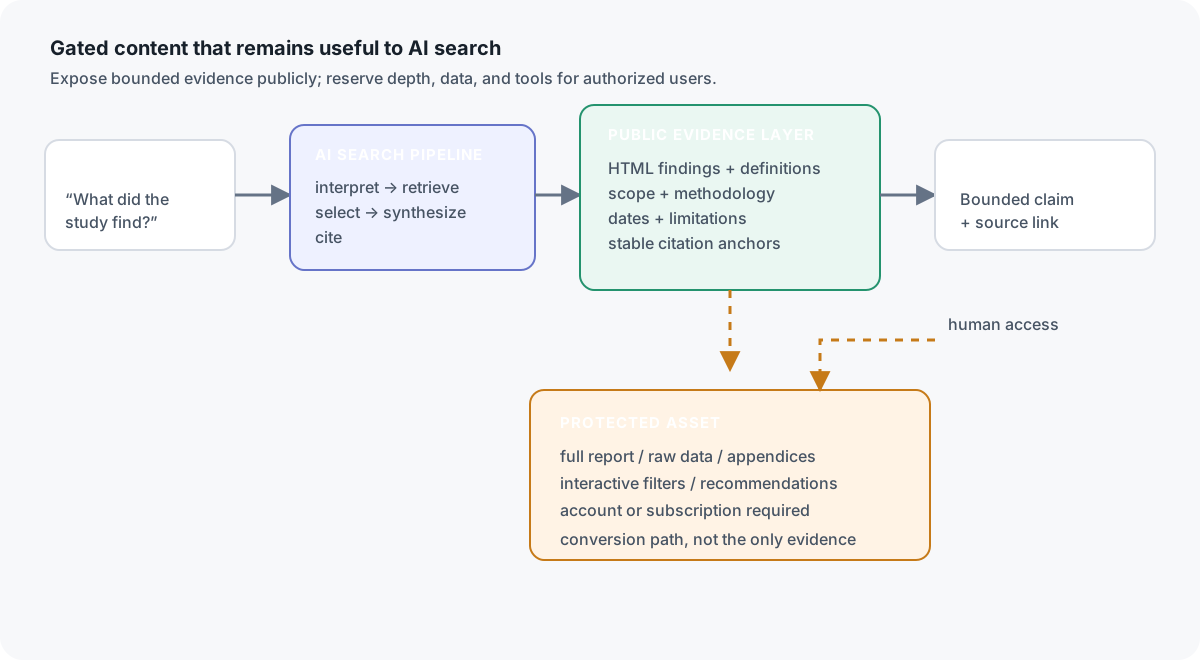
- Discovery: a linked, canonical HTML page can describe the asset and enter normal search discovery.
- Retrieval: stable headings and self-contained passages give a search system text it can fetch and match to questions.
- Citation: dates, scope, definitions, and claim-specific URLs make attribution possible and honest.
- Conversion: the protected asset can add data, interactivity, personalization, and depth rather than being the only place a fact exists.
What a crawler can and cannot do at a gate
A public crawler generally operates without a user session. It can request the landing page, follow permitted links, render some page content, and observe the response it receives. It cannot legitimately impersonate a subscriber, solve a registration workflow, or use a private API token. “The content is available after sign-in” therefore means “the content is unavailable to this retrieval path,” even if a human can reach it.
A robots.txt file is not a paywall. RFC 9309 describes crawler instructions, while authentication and authorization must be enforced by the server. Conversely, allowing a crawler to fetch a page does not make an authenticated document public. Teams need an explicit policy for each URL and agent: public search discovery, user-requested fetch, internal indexing, and subscriber access are different trust boundaries.
A precise diagnosis beats a binary “indexed” label
✗ Un-optimized
“Our report is online, so AI can use it.”
✓ Triple-rich rewrite
“The report landing page is public and crawlable; its HTML exposes the scope, dated findings, definitions, and limitations. The downloadable data and full recommendations require an account.”
Pattern 1: the evidence landing page
The most durable pattern is a canonical HTML landing page that stands on its own. It should answer the obvious question before asking for an email: what is this, who produced it, what population or period does it cover, what did it find, and what is not included? The download form can then invite a reader who wants the complete asset.
Write the public summary as evidence, not advertising. “Our report reveals surprising trends” is difficult to retrieve and impossible to verify. “In the 2026 survey of procurement leaders in the United States, respondents most often named implementation complexity as the primary barrier; the sample excludes agencies” gives a system entities, date, population, measure, and limitation. It is useful even when the report itself remains protected.
- Use a stable, indexable URL and one canonical version of the landing page.
- Put the asset title, publisher, publication date, update date, scope, and methodology in visible HTML.
- Publish several bounded findings with their units, denominators where relevant, and qualifiers.
- Define specialized terms and distinguish observed results from author interpretation.
- Link to the protected asset with an explicit label such as “Download the full report.”
- Keep the public summary useful if the form is abandoned; do not hide every meaningful sentence behind the form.
Pattern 2: claim pages and evidence fragments
A large report may answer hundreds of questions. One landing page can become unwieldy, and a PDF may not expose passages cleanly to retrieval systems. Create a small set of public HTML pages for the important themes or findings. Each page should have a narrow question, a self-contained answer, and a link back to the report and methodology.
These are not thin doorway pages. Each fragment needs original explanatory value: the claim, context, boundaries, source identity, and related questions. Use descriptive headings and ordinary text rather than placing the only explanation inside an image, canvas, or downloadable file. A fragment can quote a short result or summarize a table without publishing the full table or underlying respondent-level data.
<article>
  <h1>What did the 2026 benchmark measure?</h1>
  <p class="answer">
    The benchmark compares ... across ... during ... . It does not measure ...
  </p>
  <p>Finding: ... [scope, unit, and limitation]</p>
  <p>Method: ... <a href="/research/2026-benchmark-methodology">read the method</a>.</p>
  <a href="/research/2026-benchmark-download">Download the full benchmark</a>
</article>
Pattern 3: public metadata, private payload
Downloads deserve special care. A PDF, spreadsheet, or slide deck can be technically reachable while remaining difficult to retrieve, parse, or cite. Put descriptive metadata and a text summary in HTML, link to the asset with a stable URL, and make the access response explicit. For a protected download, return an authorization challenge or a clear sign-in response—not a misleading copy of the public page at the file URL.
A public metadata layer can include the file type, version, checksum or revision identifier, language, publication date, covered geography, and a short abstract. It should not expose credentials, signed URLs that are intended to be private, personal data, or a supposedly secret file through an accidentally public object-storage path. Security review and search optimization are separate checks.
What belongs above and below the gate?
There is no universal percentage of a report that should be public. The boundary should follow the product’s value and the risk of disclosure. Publish enough to make a claim interpretable; retain enough to make access worthwhile and to protect sensitive material. A useful test is whether a reader can understand a public finding without guessing at its population, date, or definition.
A defensible boundary
✗ Un-optimized
Public: “Download our 80-page report to see the findings.”
✓ Triple-rich rewrite
Public: executive summary, definitions, methodology, selected findings, limitations, and a cited sample. Protected: complete dataset, cross-tabs, appendices, interactive filters, forecasts, and implementation playbooks.
- Usually public: question, scope, dates, authorship, definitions, method, representative findings, limitations, and revision history.
- Often protected: raw records, respondent-level data, exhaustive tables, proprietary models, custom segmentation, and detailed recommendations.
- Public only with care: previews or excerpts that could reveal personal, confidential, regulated, or licensed information.
- Always explicit: which statements describe the public summary and which require access to the complete asset.
Structured data helps describe access; it does not replace evidence
Google documents a flexible sampling approach for subscription and paywalled content, including structured data that identifies the content protected by a paywall. That markup helps search systems understand an access model and avoid mistaking a legitimate gate for deceptive cloaking. It does not manufacture a summary, guarantee inclusion in AI features, or authorize a crawler to read subscriber-only text.
Use structured data as a consistent description of the page that a user and crawler actually receive. Keep access labels, visible text, canonical URLs, and structured data aligned. Do not put a complete article in structured data while returning only a form to an unauthenticated visitor. Do not mark promotional copy as paywalled article content merely to qualify for a feature.
Common architectures that fail
- Form-first landing page: title, hero image, and a lead form reveal no finding, so there is little useful retrieval evidence.
- PDF-only publication: the important facts are trapped in a file with poor extraction, unstable URLs, or no HTML context.
- Client-only summary: JavaScript fetches the evidence after a session check, leaving the initial document empty to many fetchers.
- Image-of-text chart: a chart may be visually clear but offers no reliable text for matching, definition, or citation.
- Snippet mismatch: the public page promises a result but only delivers it after an account, creating a weak or misleading source.
- Accidental preview leak: an object URL, API response, or cached export exposes the protected payload outside the intended authorization boundary.
The answer is not to make every asset fully open. It is to decide which failure is acceptable. If a chart is strategically valuable, publish its interpretation and scope in text while retaining the underlying dataset. If a report is sensitive, publish a redacted methodology and non-sensitive conclusions. If a customer portal contains private results, publish only aggregate, consented evidence on a separate public page.
Measure the full path from question to citation
A successful form conversion tells you that a person submitted an address. It does not tell you whether an answer engine can discover or cite the evidence. Build a test set around real questions and inspect each stage. Record the URL, response status, rendered and raw text, access state, date, and the exact passage that supports a claim.
- Discovery test: can a public search find the landing page for the question and the named asset?
- Access test: does an unauthenticated request receive the intended public evidence rather than an empty shell or an accidental private payload?
- Retrieval test: do representative queries return passages containing the claim, scope, and qualification?
- Citation test: does the answer link to the stable evidence page, and does that page support the wording used?
- Drift test: after a report update or gate change, are the date, version, excerpts, canonical link, and structured data still aligned?
evidence_contract:
  public_url: "/research/2026-benchmark"
  access: "summary public; download requires account"
  claims:
    - id: "finding-01"
      passage: "scope, result, unit, and limitation in HTML"
      source: "/research/2026-benchmark#finding-01"
  protected: ["raw data", "full tables", "implementation playbook"]
  checks: ["status", "rendered text", "retrieval", "citation", "version"]
Treat citation as a promise about support
A citation is not a reward for having a page. It is a promise that the linked source supports the nearby claim. If a public summary says “the benchmark found X” but omits the population and period, an answer system may repeat an overbroad version. Put qualifiers close to the finding and use anchors or stable section URLs when possible. If a claim is available only in the gated asset, the public page should say so rather than implying that its teaser proves the whole conclusion.
Review answers for three errors: scope inflation, access confusion, and version confusion. Scope inflation turns a sample into a universal fact. Access confusion cites a landing page as if the model read the private appendix. Version confusion uses an old finding after a report update. These are content-governance problems as much as retrieval problems.
A practical rollout sequence
- Inventory every gated asset, its canonical URL, access rule, file location, owner, revision date, and sensitive fields.
- Select the customer questions and claims that deserve public evidence; exclude confidential and identifying material.
- Create the HTML evidence layer before changing the form or paywall. Include scope, method, findings, limits, and links.
- Make the technical contract explicit: status codes, canonicalization, rendering, robots policy, structured data, and authorization.
- Run unauthenticated and authorized tests separately. Confirm that the public response is useful and the protected response remains protected.
- Sample AI answers and manually verify each citation. Record whether the answer used the public summary or made an unsupported leap to the full asset.
- Version the evidence layer with the asset. When a finding changes, update dates, excerpts, anchors, and internal links together.
This article describes an architecture pattern, not a guarantee of inclusion in any search or answer product. Crawlers, access policies, indexes, parsers, and citation interfaces change; test the current public response and preserve the evidence used in each evaluation.